artist | theater-maker | poet | dork

ART ⠀⠀⠀⠀⠀⠀⠀⠀⠀WORK
hamlet... in space! (essay)

Hamlet… IN SPACE!


In his book, Theater of the Unimpressed, Jordan Tannahill coins a term: Museum Theater, which he defines as “productions of plays that are content to simply be relics from the past. History lessons…, the killing and stuffing of once-mighty plays into theatrical taxidermy”. Broadway spits out another production of Glengarry Glen Ross, The Crucible, and Who’s Afraid of Virginia Woolf? like clockwork every few years, while across the pond the Globe Theater in London was directly conceived as a kind of theater museum, a place where today’s audiences could experience Shakespeare’s work as it was experienced at the time. A 2016 revival of My Fair Lady at the Sydney Opera House (directed by Julie Andrews herself) went so far as to exactly replicate the original’s production design from sets to costumes to lighting.

In response to criticism of this kind of theater a variation upon it has emerged, as the savvier artistic directors and producers search for a middle ground between the critical mandate for new and innovative theater and the financial security of known IPs. (It’s perhaps worth noting that the aforementioned production of My Fair Lady sold more tickets than any other in the history of the Sydney Opera House.)

I call this kind of production Hamlet in Space, named for the dialogue I imagine as its genesis:

ARTISTIC DIRECTOR
We need one more production to round out this season.

PRODUCER
Hmmm… We haven’t got a Shakespeare yet.

ARTISTIC DIRECTOR
Okay, what about… Cymbeline?

PRODUCER
Nobody’s heard of Cymbeline. Josh O’Connor’s not gonna play Cymbeline.

ARTISTIC DIRECTOR
He’s too young to- Okay fine, what about The Merchant of V- actually now’s probably not the time, is it?

PRODUCER
How about Hamlet? Everybody loves Hamlet.

ARTISTIC DIRECTOR
Ooh, and Josh O’Connor should definitely play Hamlet. But I don’t have any ideas for a production of Hamlet. And we can’t just do a straight production of it, everyone does that. Our subscribers expect more interesting work from *THEATER COMPANY REDACTED*.

A long pause.

PRODUCER
What about Hamlet… in SPACE?

ARTISTIC DIRECTOR
Hmmm. That could be interesting… Something about isolation, and being separate from the real world, looking down at it… Still, I’m not sure it totally works. Let me think-

PRODUCER
Huh? What are you saying? Whatever, I just sent out the email: Hamlet in Space opens in 3 months. Oh, and Josh is filming a movie for two of them. Good luck!

In other words, Hamlet in Space refers to a new production or adaptation of a recognizable text written more than… let’s say 50 years ago or so, with something unique (and, more importantly, marketable) stapled to its forehead.

a. A strikingly different setting, whether location or era based (sometimes as a framing device, sometimes as the entire production).
Macbeth in WW2; Othello in 2000s Iraq; Ubu Roi presented as the adolescent daydreams of an angry French teen whose parents are having a dinner party.


b. A compelling visual and/or theatrical style.
A Midsummer Night’s Dream with circus performers; A Doll’s House with no props; The Tempest but Ariel is on a screen.


c. An unorthodox casting choice, which usually involves either gender-bending, race-bending or character doubling. (Celebrity casting alone doesn’t count.)
Uncle Vanya but everyone is Andrew Scott; The Tempest but it’s Sigourney Weaver playing ProsperA; Death of a Salesman but they’re a black family.


d. A modern reimagining by a contemporary playwright that has something to say about the original property. (West Side Story doesn’t count, but & Juliet does.)
Fat Ham, A Tempest, A Doll’s House Part Two, John Proctor is the Villain


e. A combination of the above.

I should also clarify that, just as setting your production of Hamlet in space doesn’t automatically make the production a Hamlet in Space, just because a production fits into the genre of Hamlet in Space, does not mean it’s going to be bad. There’s nothing inherently wrong with any of these approaches to theater-making, and in fact some of the examples listed represent the best theater I’ve ever seen. The problem is a growing tendency for productions to be devised concept-first, seemingly more worried about the poster than the production, and left with no time to explore or develop the concept and find out what, if anything, is underneath.

Take the 2025 production of The Picture of Dorian Gray for example, in which Sarah Snook played an astonishing 26 roles. Central to the production were a collection of moving screens, onto which were projected live feeds from onstage cameras as well as pre-recorded footage, all of which allowed Snook to play the narrator and all the characters in a retelling of Oscar Wilde’s only novel, The Picture of Dorian Gray. I mention the narrator because, though they appear relatively rarely, they are the character with which the production begins and ends. They also represent the central problem with the production.

Let’s back up a bit: what is The Picture of Dorian Gray about? Well, plot-wise, it’s a story about a beautiful young man in 19th-century England who, upon seeing a finished portrait of himself, declares that he would sell his soul if he could stay as young and beautiful as he is now and the painting would age in his stead. His wish is granted, and he lives an immoral and hedonistic life for decades, with the only fallout the aging and scarring of the portrait he keeps locked away from view. There’s a bunch of plot after that but all you really need to know is he fucks up a bunch of people’s lives, murders the painter with a knife so he can’t tell everyone his secret, and eventually stabs the painting with the same knife. When his servants enter the room, they find the body of an impossibly old man with a knife through his heart, in front of a painting of a beautiful young man, totally intact. Good, right?

Now back to the narrator: the narrator is the first person to talk to us, setting the stage with the first lines of the novel. They are clearly very excited, almost breathless, to tell us this story. Soon the telling is being done by the characters Snook is playing (or at least by the narrator dressed as whichever character she was playing last), and Snook as the narrator is relegated to occasionally appearing on-screen to do this shtick where they think the next section of narration is their line but so does the Snook on stage, and they argue about it. (This happens twice, if I remember correctly.) Otherwise, their only other appearance is in the final moment of the play: after still-breathlessly reciting the final lines of the novel, they inhale as if to keep talking and are immediately silenced by a blackout.

In Wilde’s original text, the story is relayed to us by an omniscient narrator. Novels, particularly those written in the 19th century, are often narrated by an all-seeing eye with no clear stakes in the action of the story; to question this is almost like questioning why a novel is written in paragraphs. Narrators in theater are much more complicated. When a play has a narrator, the world of the play is made fundamentally less real. Narrators talk to the audience, and define the plot as a story being told to us rather than a situation unfolding before us. A living, breathing narrator implies a living, breathing motive: Why are they telling us this story? What does it do for them, and why do they need us to hear it? The reason can be grandiose or minor, altruistic or selfish — In Our Town, The Stage Manager wants to explain something about life and death, about America and collective memory; in The Drowsy Chaperone, Man in Chair is sharing his favorite musical with us as a way to keep his memories alive; in Brighton Beach Memoirs, Eugene is simply a talkative and imaginative kid with little to no recognition of what he should and shouldn’t say to people.

Dorian Gray retained the narrator from the novel, but didn’t reckon with the fact that doing so added a whole new character to the story, one that I would argue has the deepest internal life of any of them. The production used doubling and on-stage quick changes to stylishly conjure each new character, but didn’t consider how an audience would experience them as all being played by a single person and, more importantly, that it would want to know why.

I want to be clear: I was incredibly impressed by this production both in terms of the technical complexity and Snook’s powerhouse performance. Seriously, the woman is amazing, and the uses of video ranged from delightful to outright astonishing. But there’s a difference between impressive and effective. And that tends to be the big issue with a Hamlet in Space: it’s often the result of dozens of majorly talented people doing truly excellent work. But when that work is in service of a half-baked idea, there’s no amount of talent that can bake it whole.

Now, we’ve gone over what Dorian Gray is about, but what’s it about about? Vanity? Morality? Homoeroticism? A different theme that isn’t listed on the Wikipedia page? Kip Williams, the production’s writer and director, says that his Dorian Gray is about “gender, […] sexuality, [and] the performance of identity”. But, beyond the choice to cast a female actor as all the characters in a story populated mostly by men (and I guess just the fact of Oscar Wilde’s queerness?), I really don’t see how the production could be read that way.

We’re back in the land of conjecture here, but in my mind it went more like this:

*ring ring*

PRODUCER
Hey, you’re the director who uses screens and video footage, right? What’s something you could adapt with a lot of screens? Preferably something that can be worked on during COVID, because as you know it is the year 2020.

KIP WILLIAMS
Yeah, we’re probably gonna want to do something with one unmasked actor and a bunch of masked stagehands if we want to rehearse properly while still social distancing…

PRODUCER
Right, exactly. Screens, one actor… something about self-obsession?

KIP WILLIAMS
I mean, I’ve always loved The Picture of Dorian Gray. Haven’t read it in a while, but-

PRODUCER
Perfect! That’s sorted.

KIP WILLIAMS
But I mean, I’m not sure if-

*dial tone*

Dorian Gray’s fatal flaw is his vanity, the belief that his beauty, and therefore he, is superior to all others. This production seems to equate vanity with self-obsession, in an attempt to draw out the kind of Black Mirror-esque themes that every modern artwork has to comment on, criticizing the rampant overuse of photo editing and how the ubiquity of screens stokes the fires of our modern self-worship, et cetera, et cetera. But Gray’s vanity is less the constant preening self-attention of an Instagram model than it is the entitlement to do anything he feels like, bolstered by a perceived superiority that, yes, derives from his external beauty.

Furthermore, the self-obsession implied by a one-actor production, like that implied by a narrator, is of a third kind, that of the know-it-all, either because they are actually omniscient or just believe they are. And there’s the rub: people who know everything make really boring characters, especially when there’s nobody and nothing there to confound this certainty. At the end of the play we have watched someone pour themselves into the performance of this story over two hours, playing all these characters with this seemingly boundless energy… But why? They’re the only quote-unquote “real” person there, the one telling us this story, the only one who we can imagine will still be there when the lights go off. The other characters are puppets: they disappear when the narrator removes their costume, placed back in their box for next time. But here is the costume they cannot take off, the version of themself who started this whole mess, who has decided to tell us this story even as it seems to drive them to a kind of insanity. They’re the only one who transcends their identity as “a character” to become a whole person that we might relate to, but they seem to have been given the least amount of thought. And this is to me what happens when a production puts the cart before the horse, under-thinking a concept into a gimmick — “What if Hamlet but… in space?”

Why does this happen? Well, no prizes for guessing what I think if you know me: it’s capitalism! Sorry, I know, I know. But it’s true: the simple fact is that theater, like any other art, is best conceived through process, allowing for discoveries and complications, tangents and dead ends. Art at its most effective, like life at its most profound, is found in the in-between, in the unique process of its incidence; it can’t be rushed or pre-planned; this is what can make it so expensive, but also what makes it human. Hamlets in Space, though sometimes invigorated by some singular talent in the cast or crew, are fundamentally inhuman products, not so much process as processed, built for purpose and designed for efficiency.

Think of it like a handcrafted bookshelf versus one from IKEA. The IKEA piece is cheaper, lighter to carry, quicker to build (even if you always end up with some extra screws and bolts you’re not sure where to put). If that’s all you can afford, it certainly does its job. But at the end of the day you’ll be left with something flimsy and impersonal that doesn’t really fit with or add to what’s around it, and no way to keep the damn thing from wobbling.

another othello (pitch deck)

othello is not considered one of shakespeare’s “problem plays”. however, in the years between the play’s writing and now, it has certainly become a problem. drawing on the work of black scholars and intellectuals like ayanna thompson, keith hamilton cobb, w.e.b. dubois and many more, another othello aims not to solve that problem, but to finally present it to an audience that has ignored it for too long.

sullivan's travels (a new musical)

adapted from preston sturges’ oscar-winning 1941 film of the same name, this in-progress musical aims to start in the risk-free silliness of the screwball comedy, follow sullivan into the idyllic tragedy of a romantic epic before suddenly shifting to a bleak, neorealism-inspired sequence as he finally experiences the true realities of poverty, and soon wishes he hadn’t.

below is the most recent draft of the script… that i’ve remembered to upload here. if you like it, and can write/orchestrate music, drop me a line!

click to download the latest draft of the script

nine the musical (pitch deck)

while nine is traditionally cast with 22 women and one man, this production will cast one actress to play (almost) all of the female parts, aided by a combination of prerecording, shadow play, quick changes of both costume and lighting, and puppetry.

a pitch deck – which includes a set design and plan, a preliminary budget/inventory as well as a fuller exploration of the production’s concept – can be read here.

this painting should've been an email (video essay)

an inflammatorily-titled, less-long discussion of how art that makes you think before it makes you feel is more criticism than art.

all er nuthin (video essay)

an in-depth exploration of how mainstream theater performs its progress on stage with “race-blind” casting, while still allowing creative control to remain majority white, and how their risk-aversion is arresting not only societal but artistic advancement. exploring topics from laurence olivier’s baffling 1965 performance as othello (and pauline kael’s equally baffling rave review), to daniel fish’s 2019 production of “oklahoma”, and beyond!

colorado (short comic)

a semi-fictionalized account of a summer i once spent in colorado, and a portrait of the more ambiguous and important relationships one can have in life, and then let go of. this was a completely individual project, written and illustrated by me alone. I think it turned out pretty good.

mother (puppet study for nine)

a work-in-progress puppet conceived for nine, portraying the main character’s mother in a way that made him child-sized. by pulling the ropes, it is possible to control the sheet so that it looks like a shawl being worn by a giant woman who isn’t there, towering over the seated actor (represented in the model below as a corkscrew). the actor reverts to childhood, the sheet becomes their mother, and they dance with her. as the two dance, she begins to bend lower and lower, before settling on the floor.

student work

look, I’m terrible at coding. I couldn’t figure out how to make one of these not open, so now it does. sue me. it’s supposed to be a header. everything below this is student work. go away.

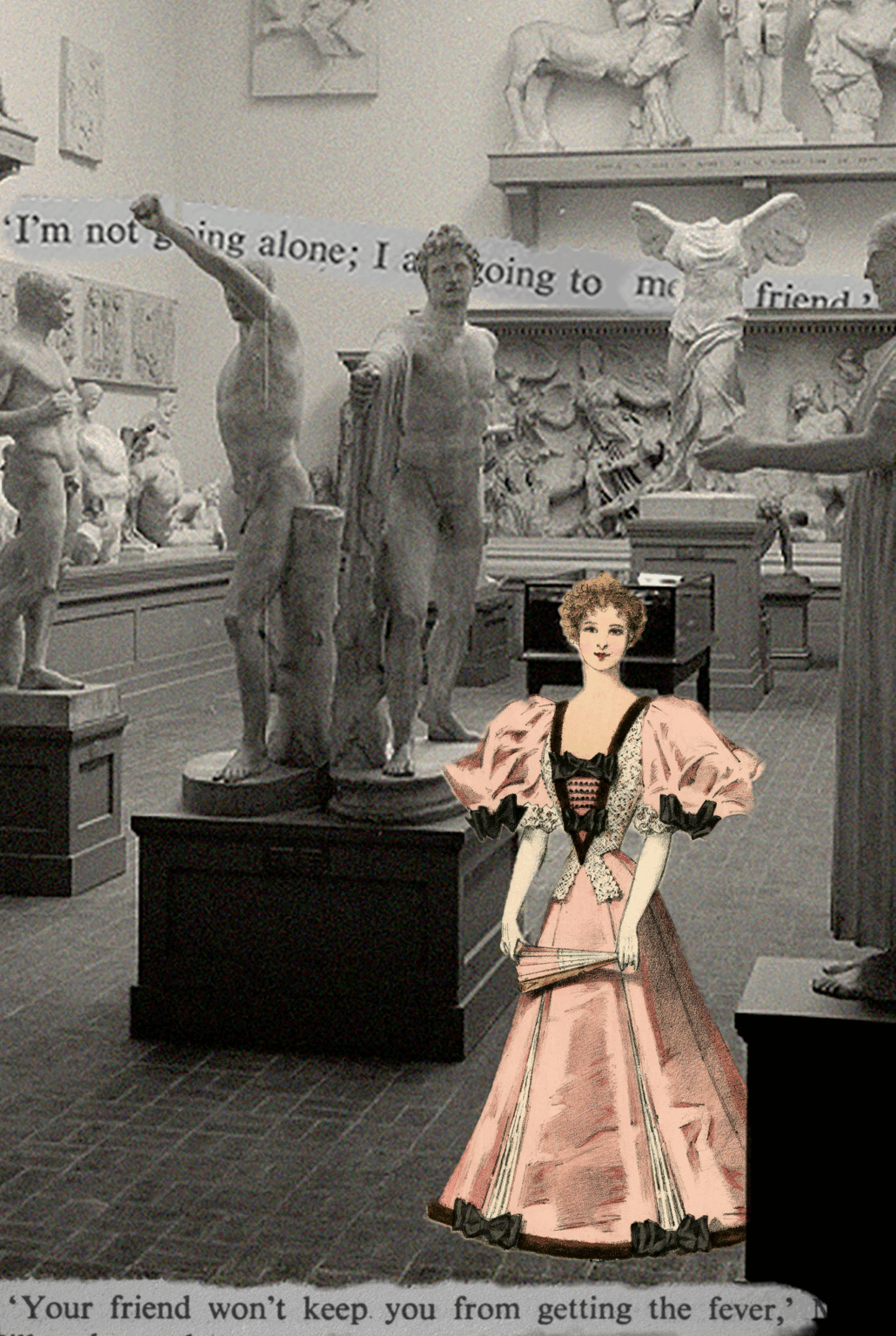
daisy miller (collage novel)
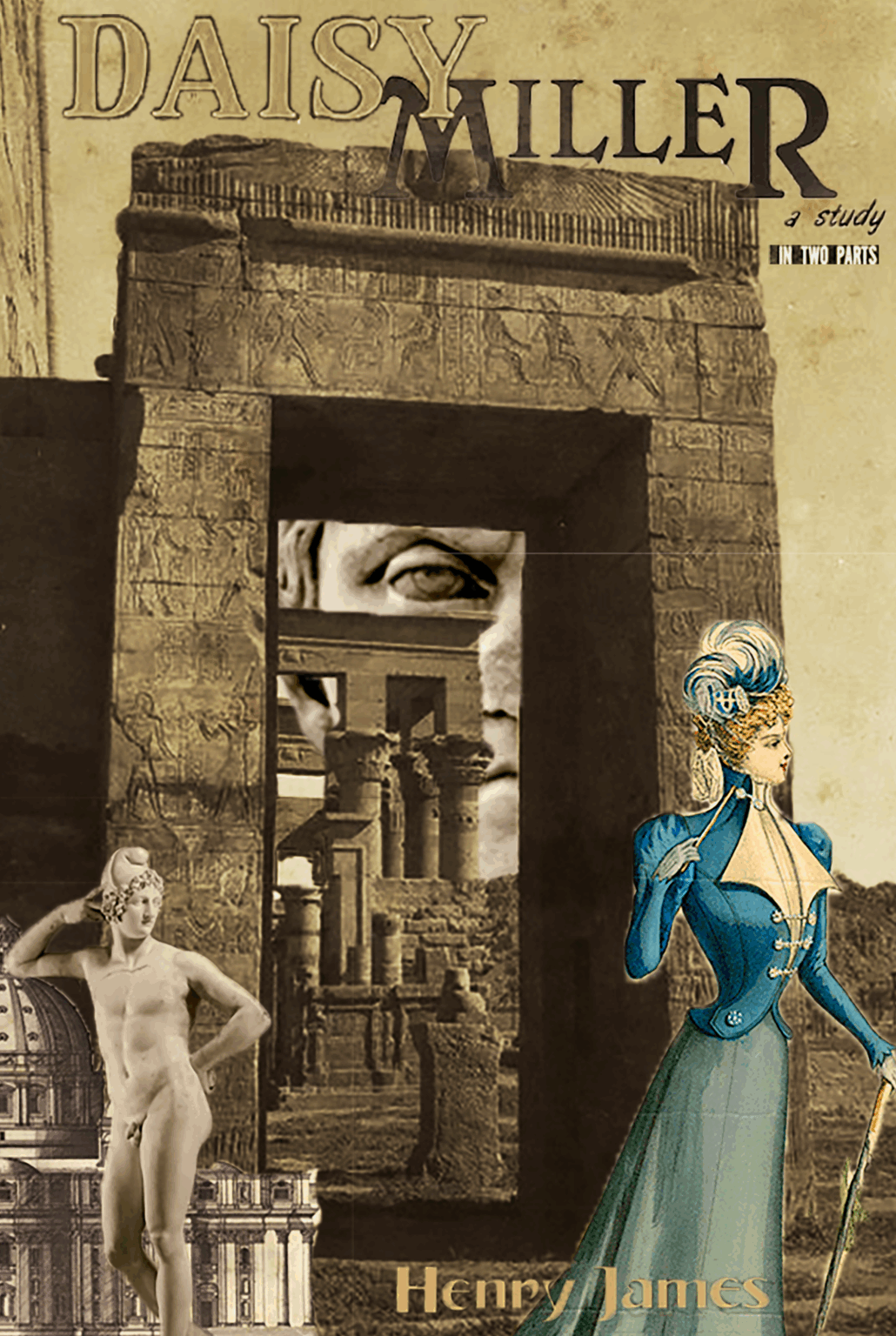
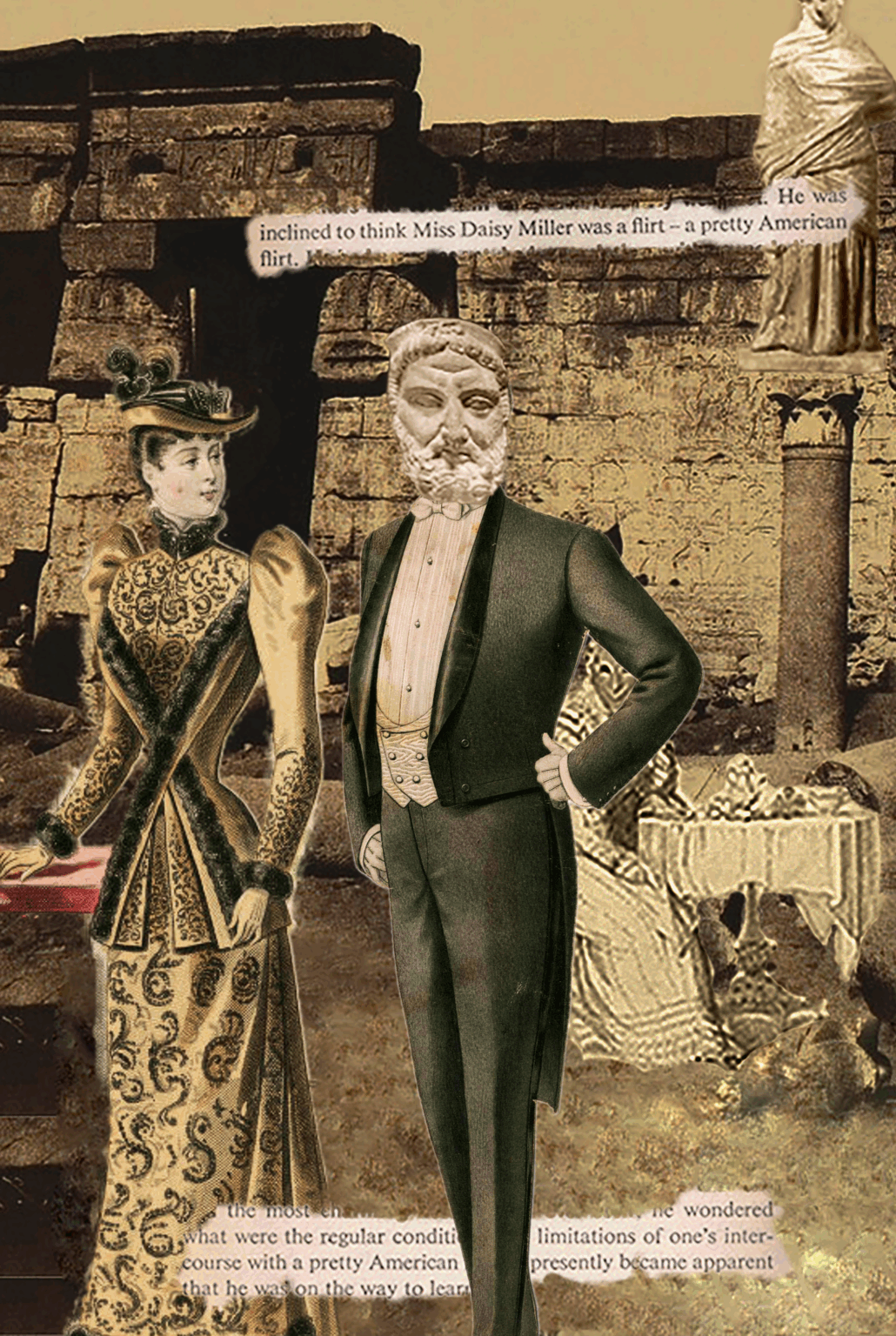
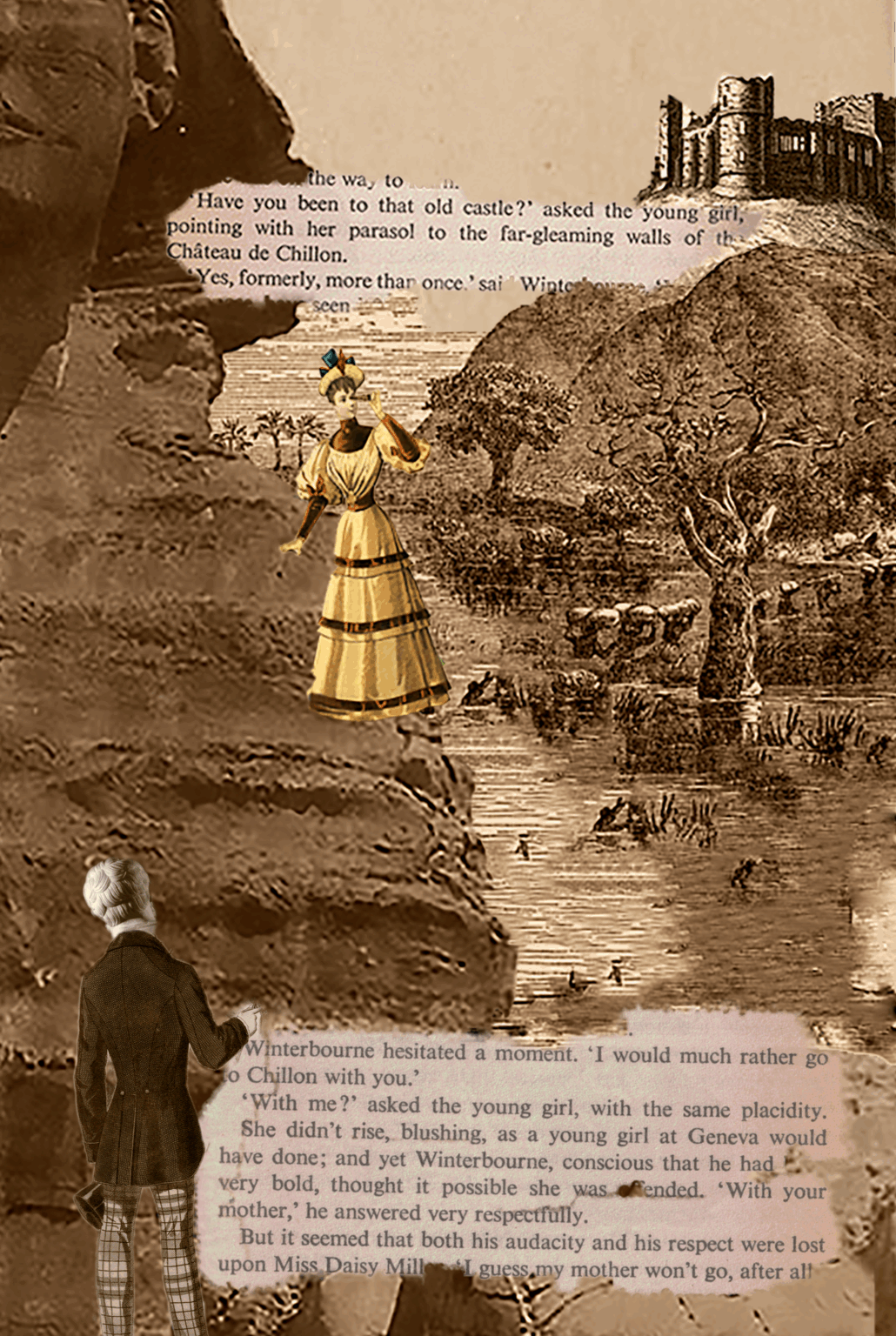
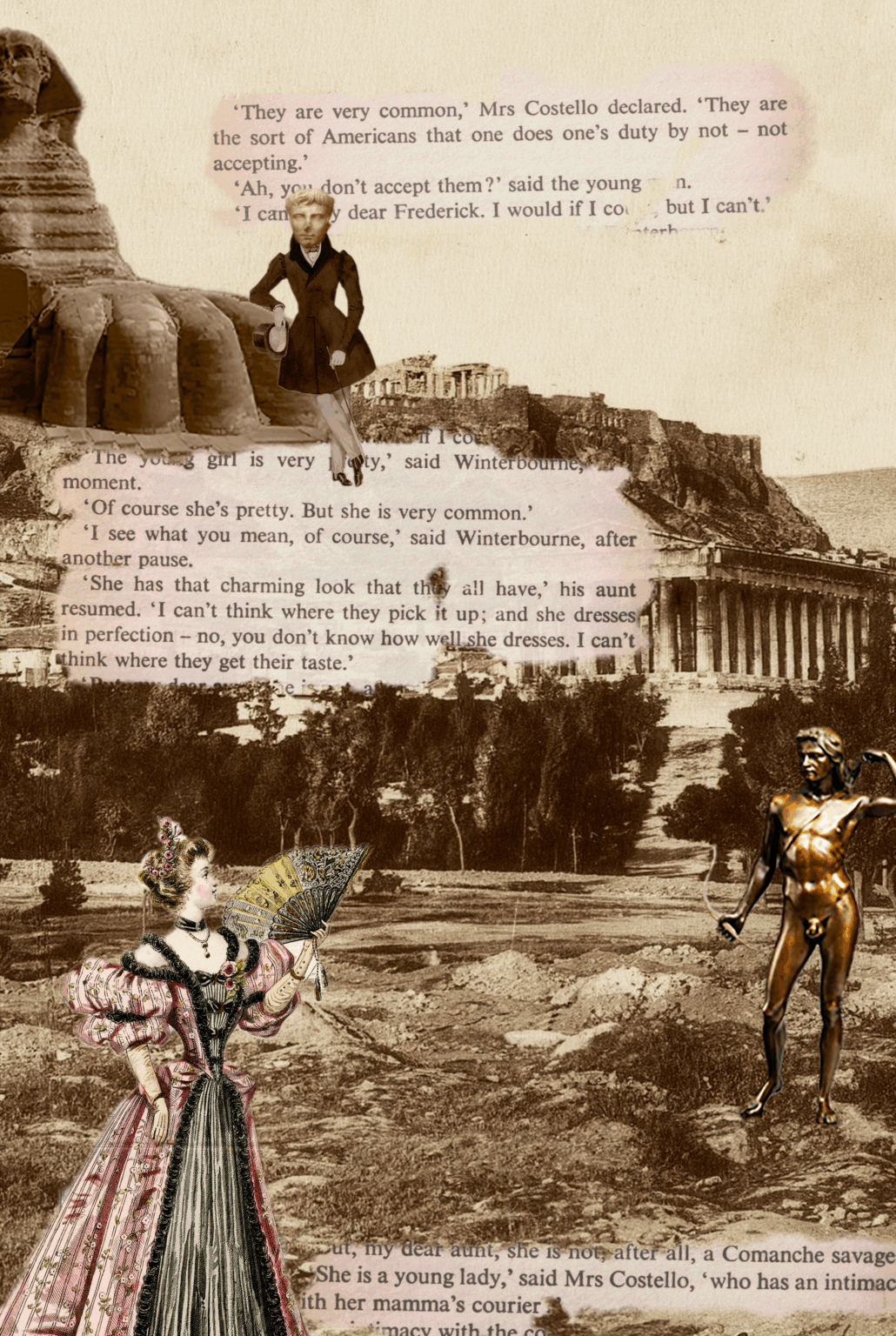
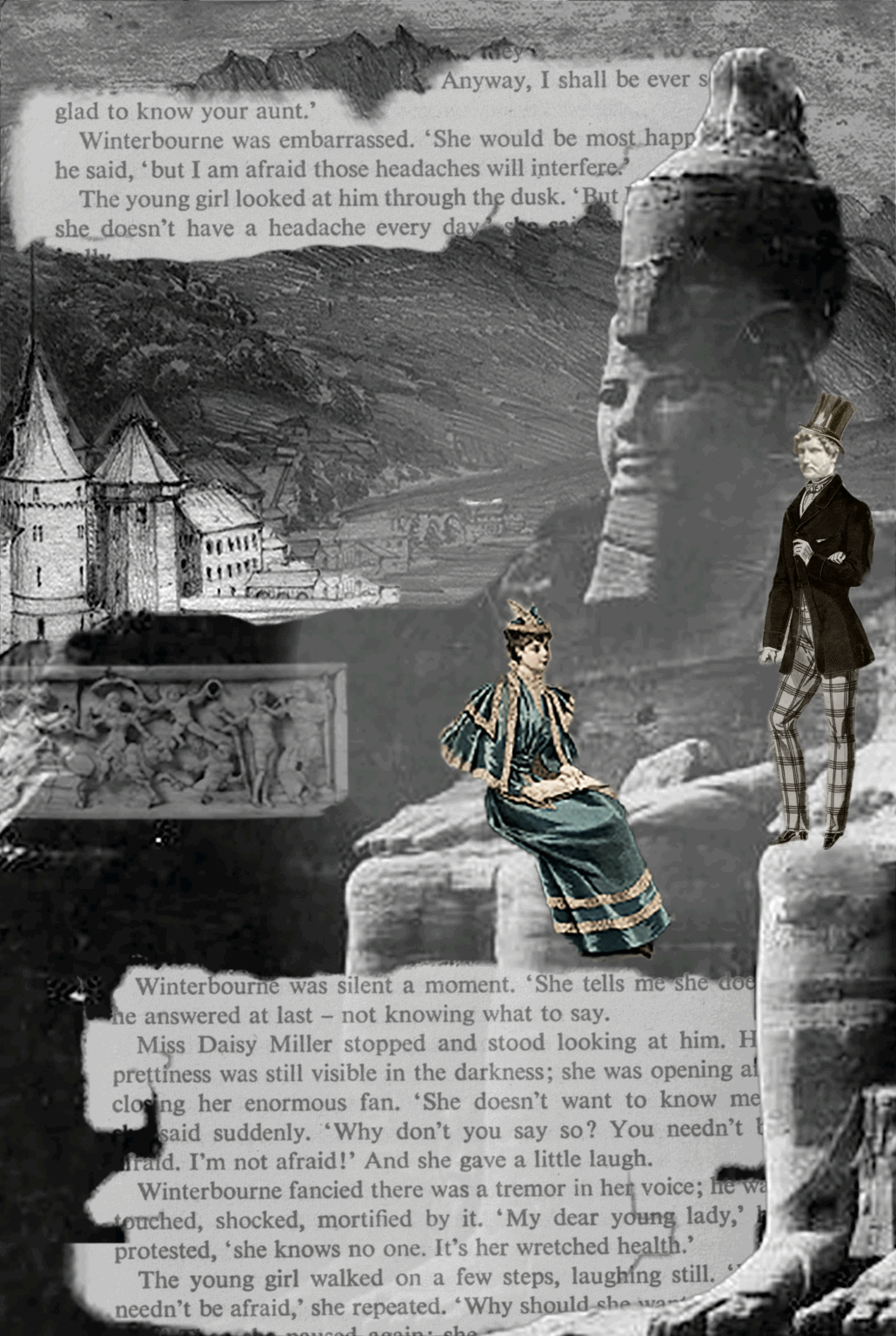
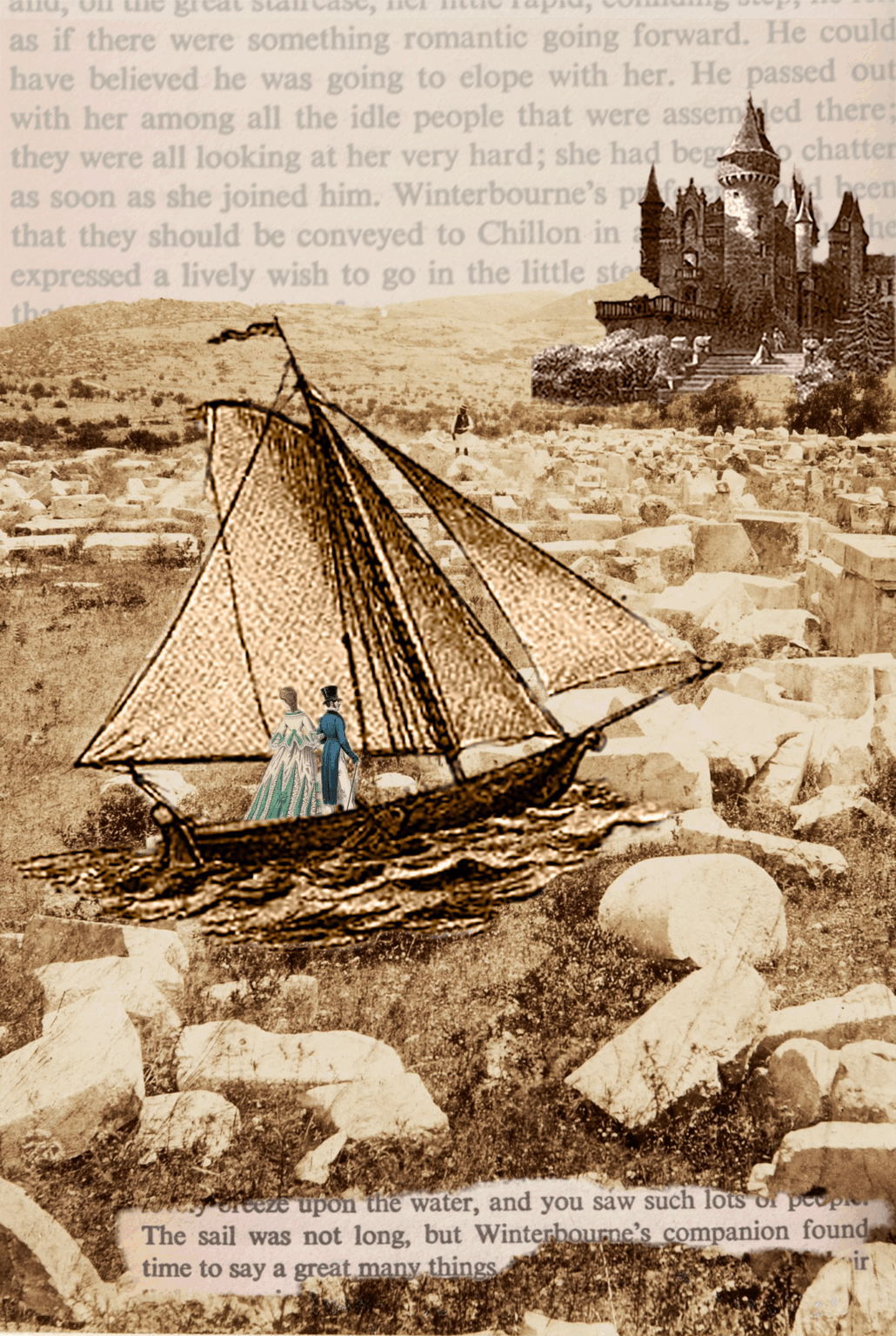
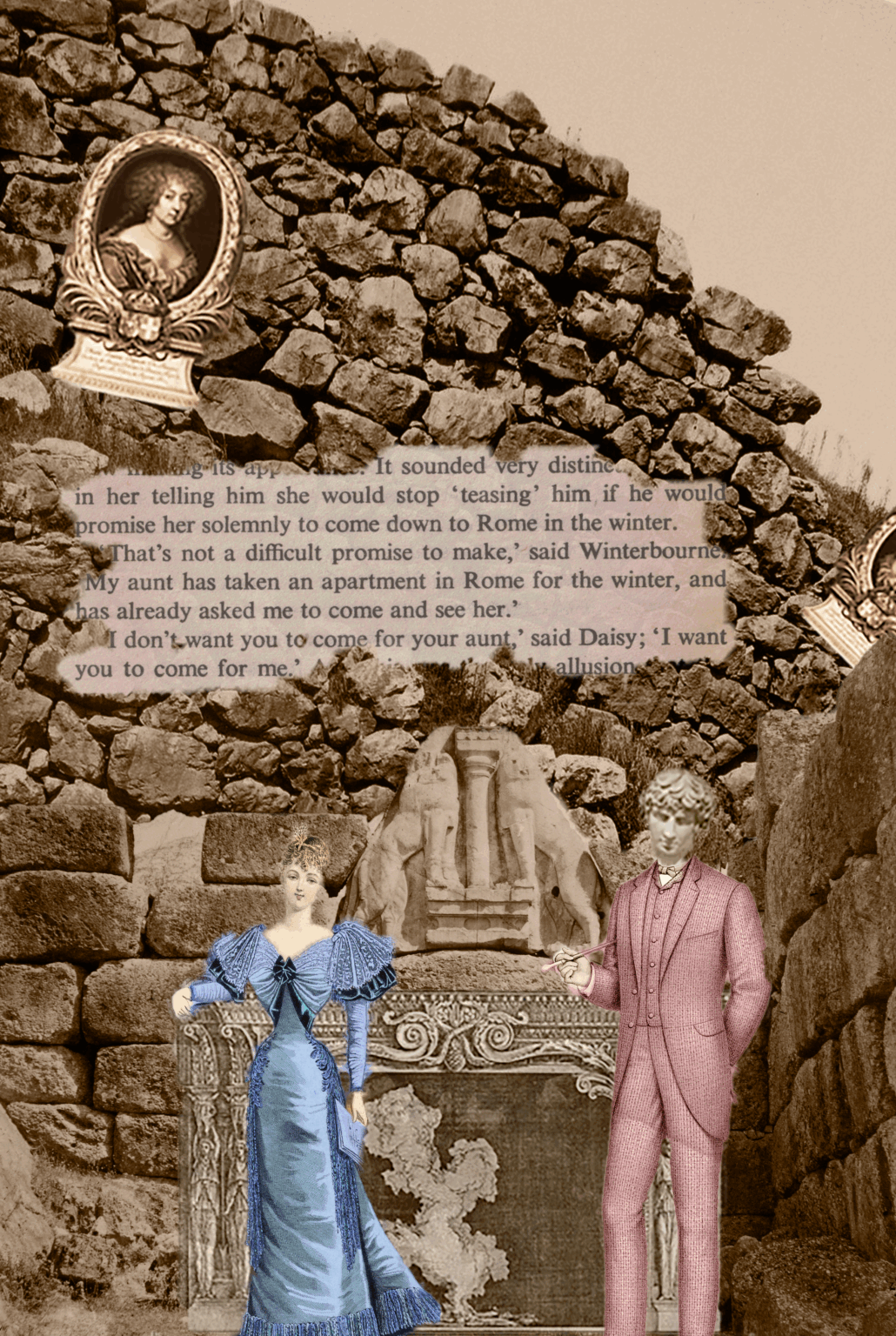
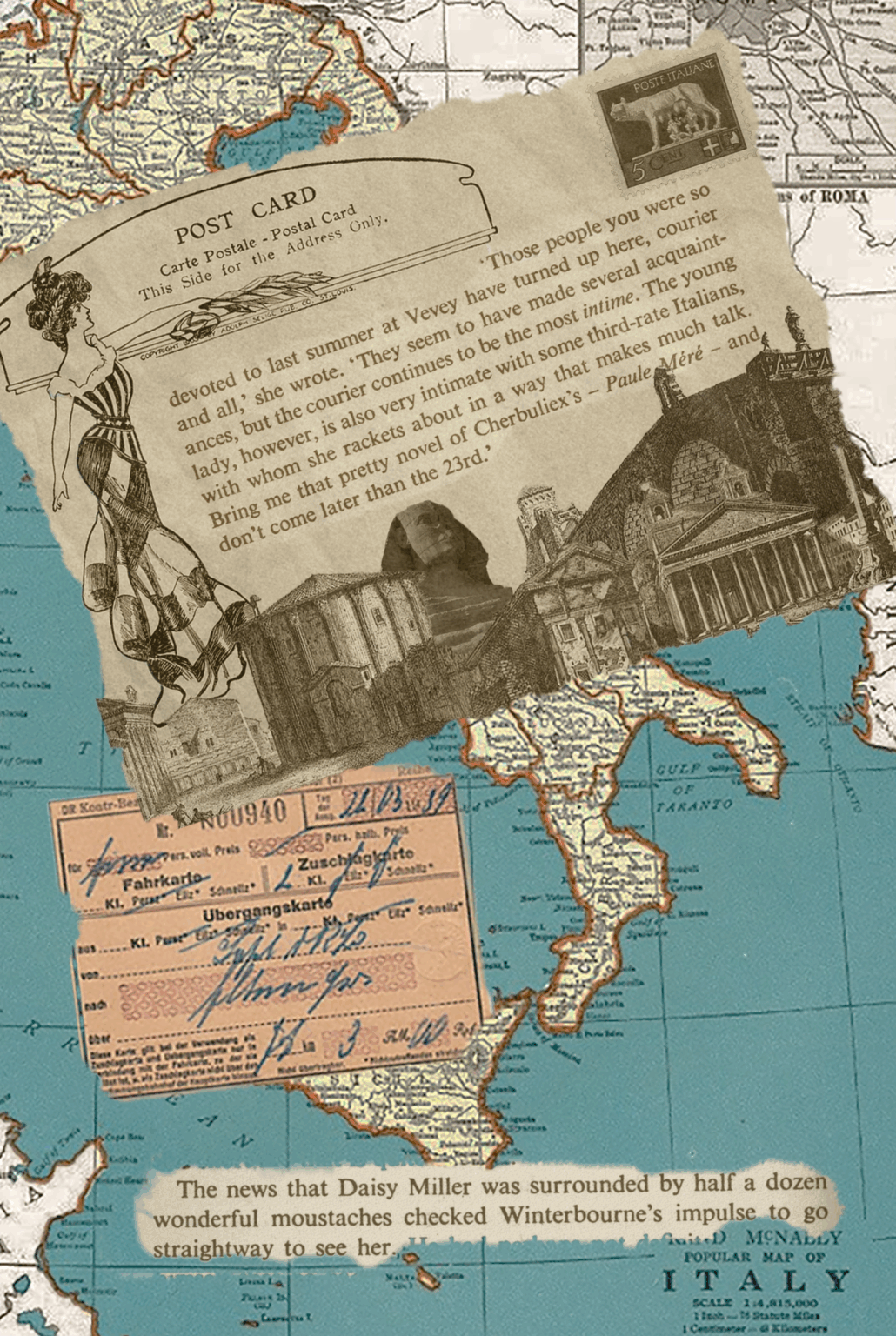
Henry James’ 1878 novella Daisy Miller – A Study in Two Parts is an example of James’ career-long struggle with his trans-Atlantic identity as a US-born Brit, and the tug-of-war between the promised freedom of America and the comfortable formality of Europe.

While over 100 years old, the novella is still deeply relatable: Daisy dies raging against the conformity expected of her, while Winterbourne gives up on his freedom in favor of stability. Collage seemed the perfect medium to express this uncomfortable juxtaposition of the old and the new, the free and the caged.

I’ll finish it one day.

mac demarco - 2 (album cover)
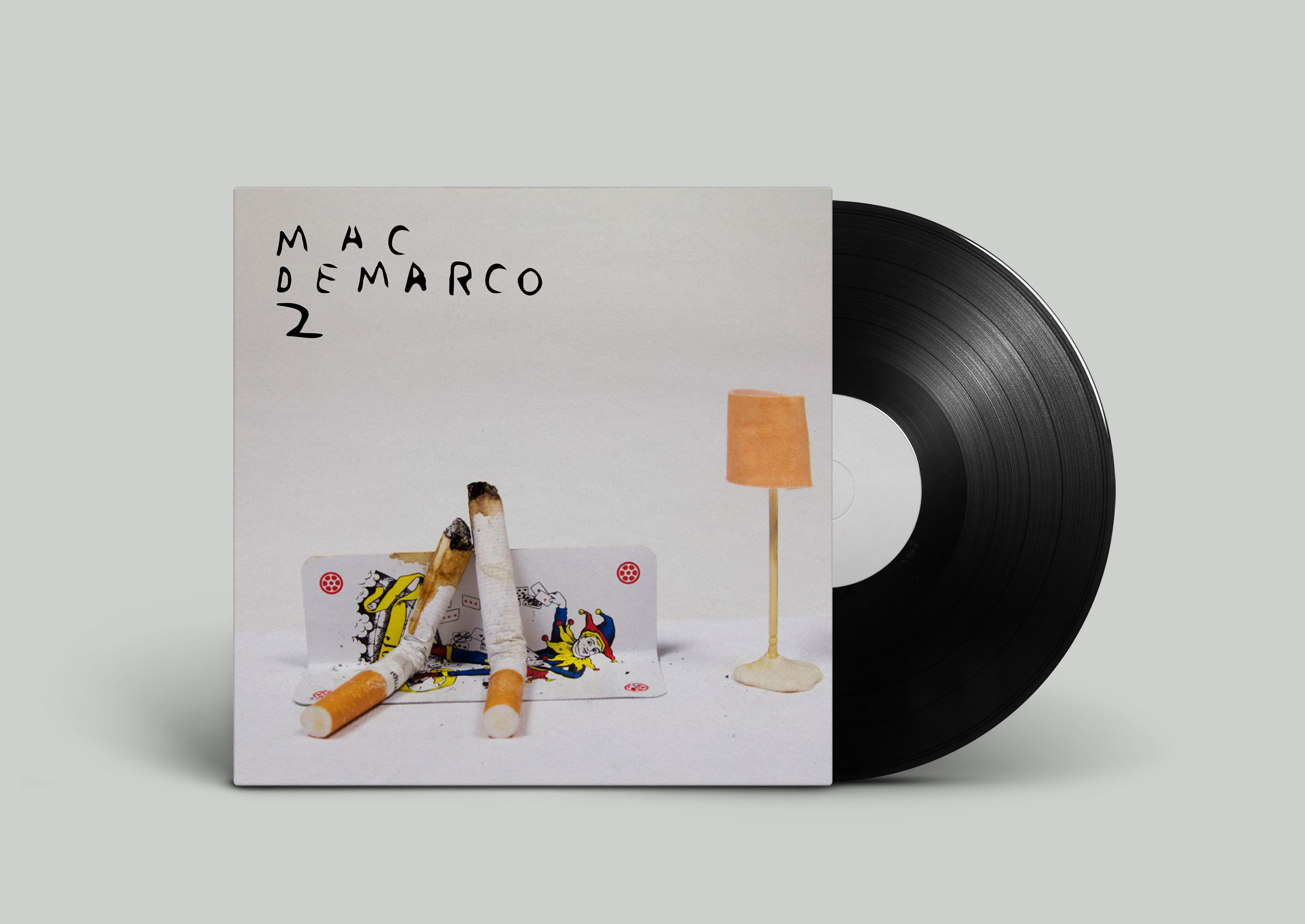
listen closely to “2”, mac demarco’s first full-length album, and you’ll find that behind the lilting psychedelic guitar and gap-toothed smile, he is detailing an at-once familiar and deeply personal picture of adolescence. he bounces effortlessly between themes, from worrying about worrying his parents to deep, guileless love, to that feeling that life has more in store for him. this album cover was created to reflect that, using dirty and classically teenage objects to create an affectionate and earnest moment.

my last duchess (shadow puppetry)

in his 1842 dramatic monologue “my last duchess”, robert browning writes in the voice of an obsessive duke showing a visitor a painting of his last wife. as it goes on, it grows more comfortable in its true form, a terrifying study in jealousy, power, and the unseen. i tried to capture that in this shadow play, underscored by erik satie’s haunting “gnosienne no.4”  to match the poem’s slow, inevitable violence.

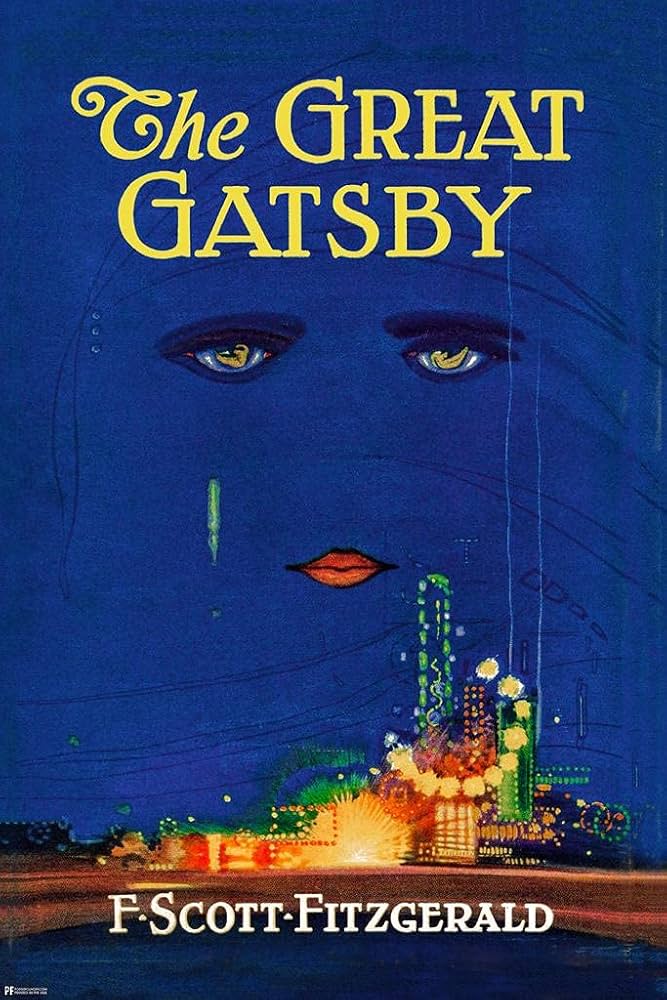
the great gatsby (dramaturgy)

OK, this is kind of embarrassing. I feel like my favorite novel should be something obscure and sexy by someone French or Japanese, but instead it’s this. I know it’s the book that every high schooler studies, the most obvious choice ever, but…
IT’S, LIKE, BASICALLY PERFECT.

Anyway I made a big interactive PDF thing for an adaptation of the play. It’s a little buggy but it works and there’s some interesting stuff in there.

nobody read it at the time, obviously.

download the pdf here! (the interactive stuff only works in adobe Acrobat)

carnival of the animals (costume design)

my first experience designing costumes was for a hypothetical production of camille saint-saëns’ posthumously-released suite the carnival of the animals, a collection of short, animal-themed pieces, complete with ogden nash’s silly interstitial poems read by a narrator. like the best children’s media, this series has plenty for adults to enjoy as well, and i wanted to capture that in my designs, focusing on recognizable characters and conflicts within each piece.

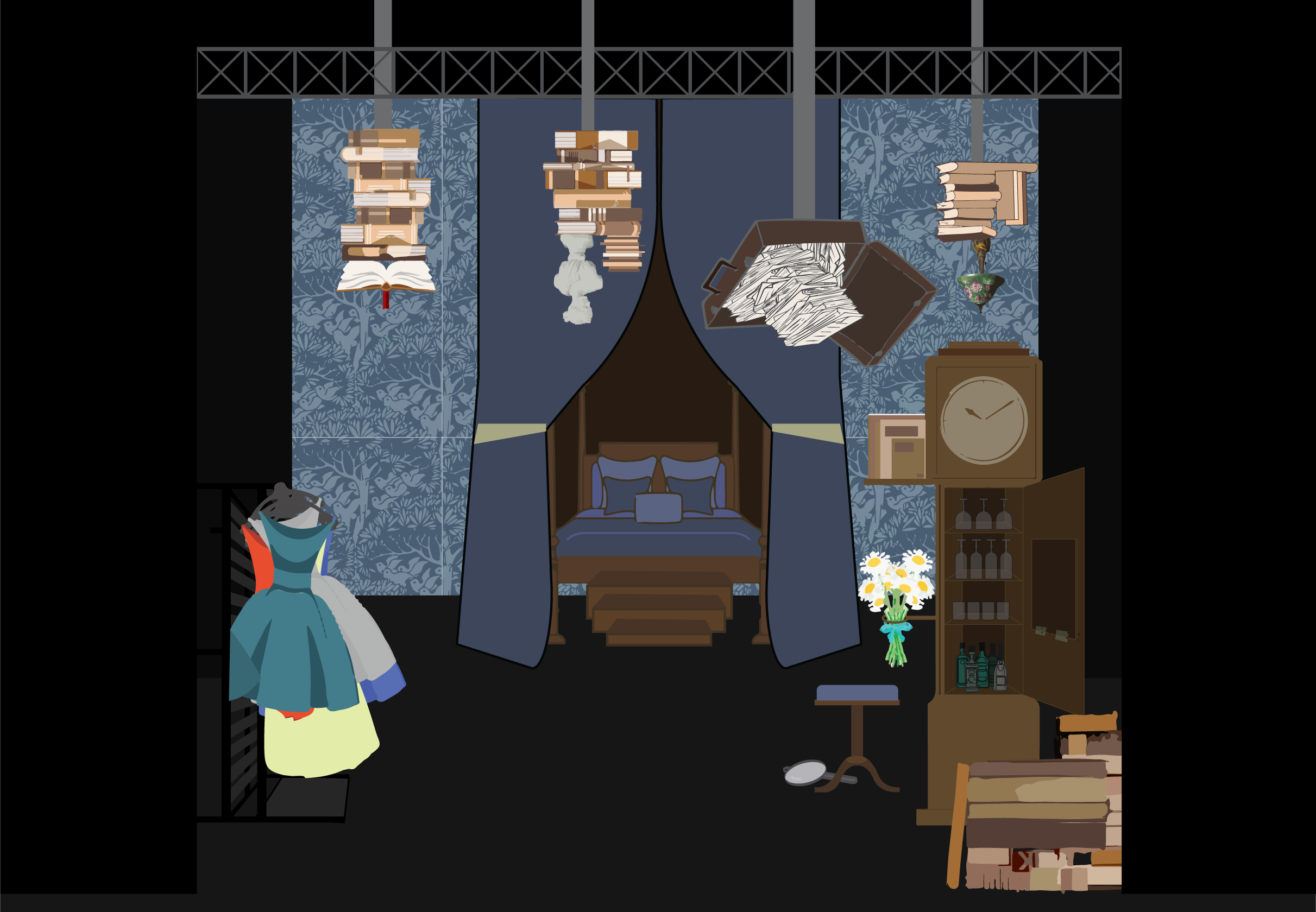
when five years pass (scenic design)

written in 1931, but only produced after his death, when five years pass is one of lorca’s most surreal plays. it explores the inescapable cycles of desire, memory, and metaphor through a story of a young man whose old love is not how he remembers her, and his interactions with personified facets of both himself and her.


the design centered around ideas of surprising but organically-uncovered set pieces, unfolding and merging the way images do in a dream.

take back the rains (awareness campaign)

take back the rains is a plan for a state-wide water rights awareness campaign to expose the stealing of our natural resources to be sold back to us.

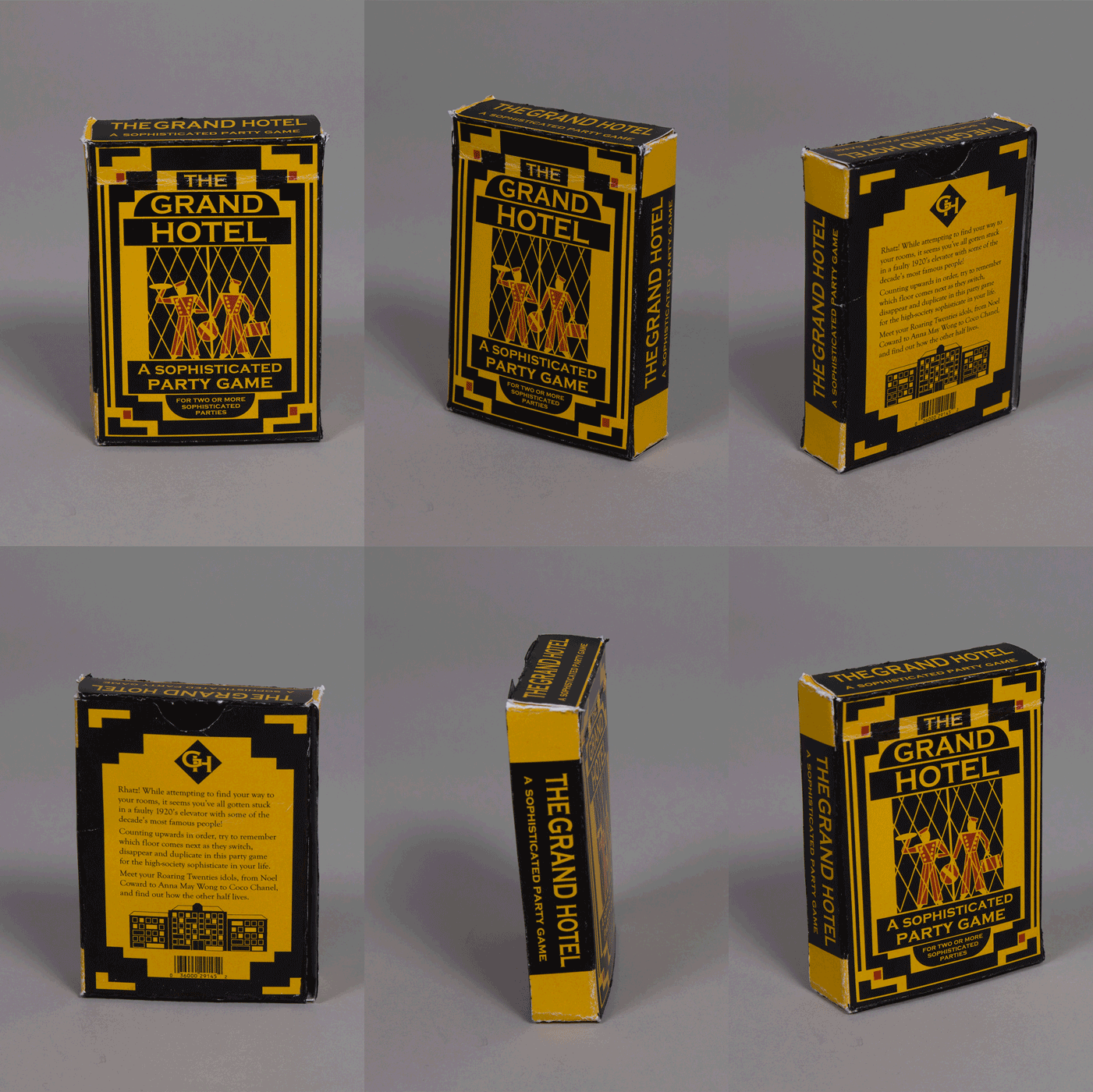
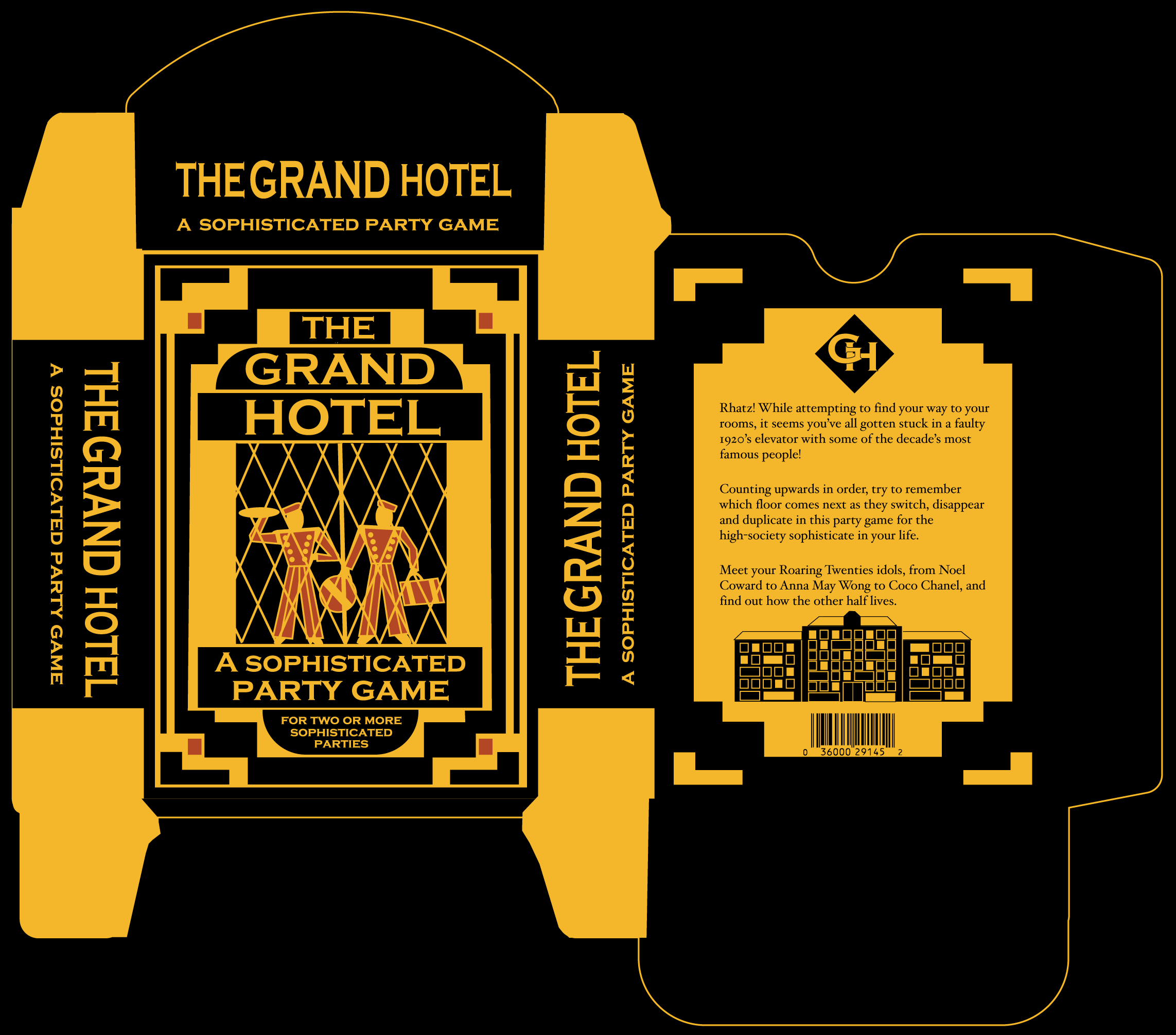
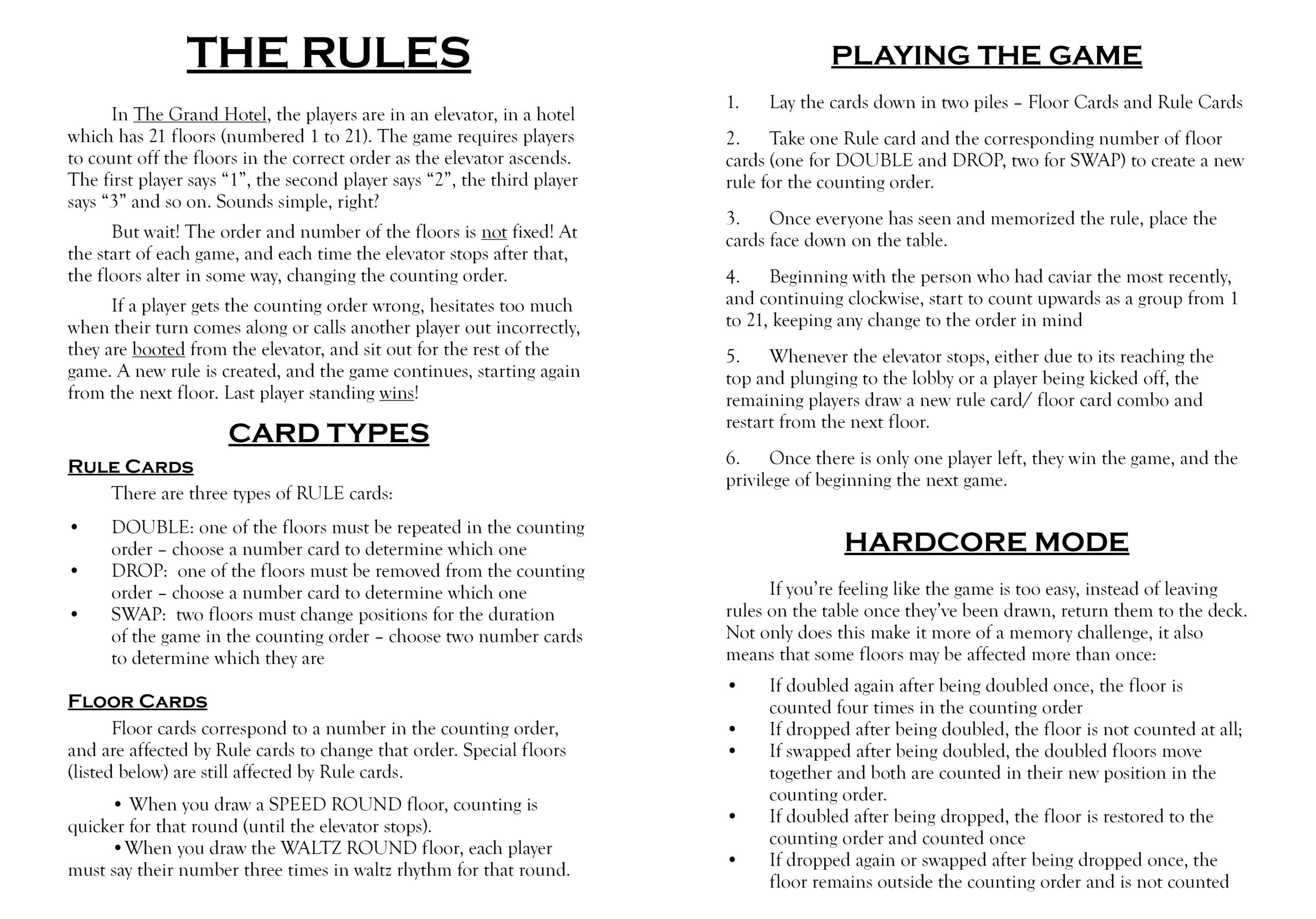
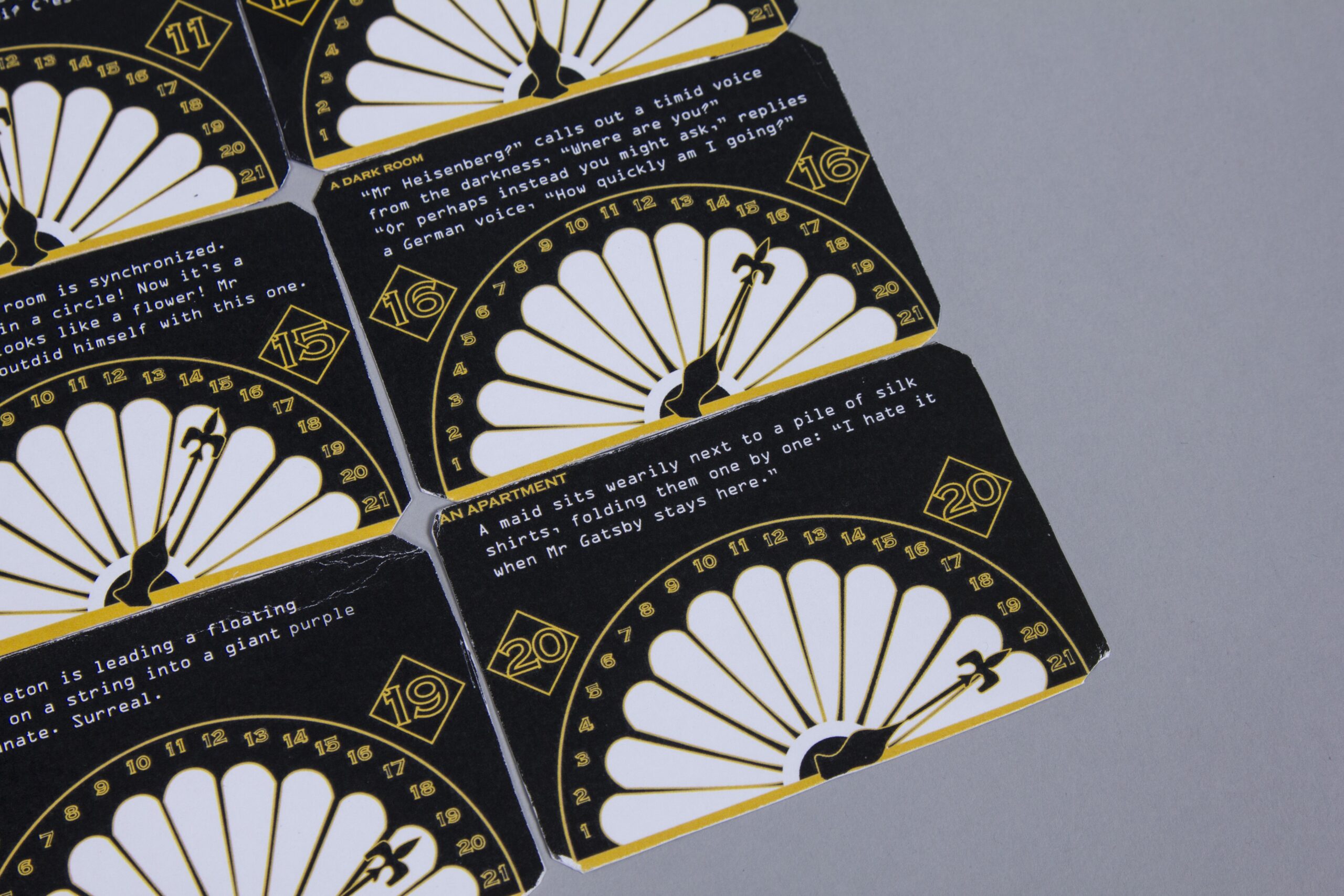
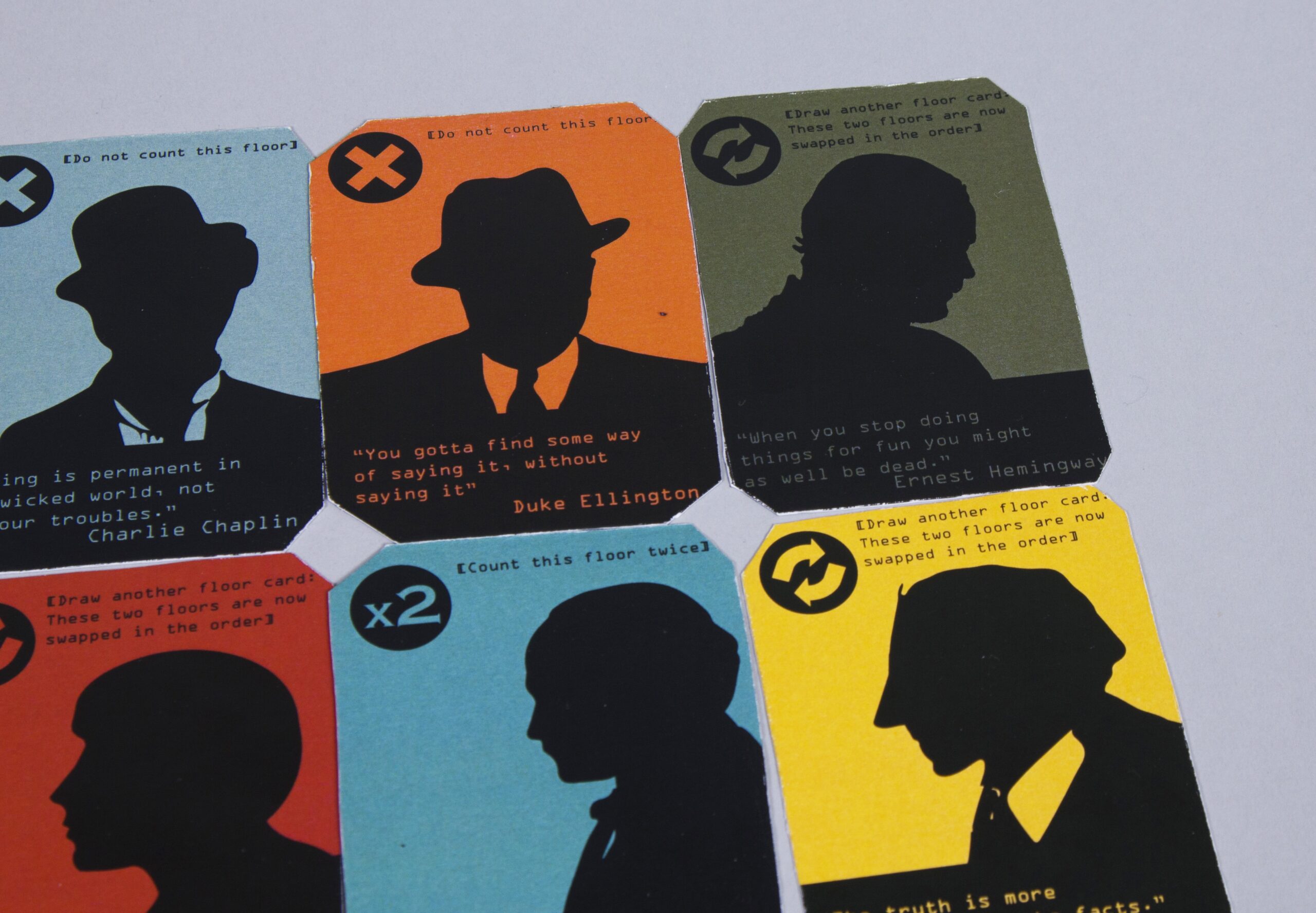
the grand hotel (card game)

the grand hotel was an independent project designed and produced alone as a solo entry to the d&ad new blood awards’ hasbro brief, which asked for a party game for millennials based on an existing game.

inspired by a drinking game and my love for the roaring 20’s, i created a luxurious, witty art deco styled card game for two or more people, printed a rough but fully playable pack, and wrote/recorded/edited a rough silly advert for it.

blood wedding (pitch deck)

Blood Wedding is a folk tragedy in three acts by Federico García Lorca, first produced as Bodas de Sangre in 1933. Langston Hughes wrote his translation around 1937, but it was not produced until 1992, sitting in archives for over 50 years.
In the below document, I propose a production of Hughes’ richly poetic translation at 26501 McBean Parkway, an unused lot in modern Santa Clarita, on the ancestral land of the Tataviam and Chumash tribes.

dynamic change consultants (website)

Dynamic Change Consultants (Design and Copy)
dcc.com

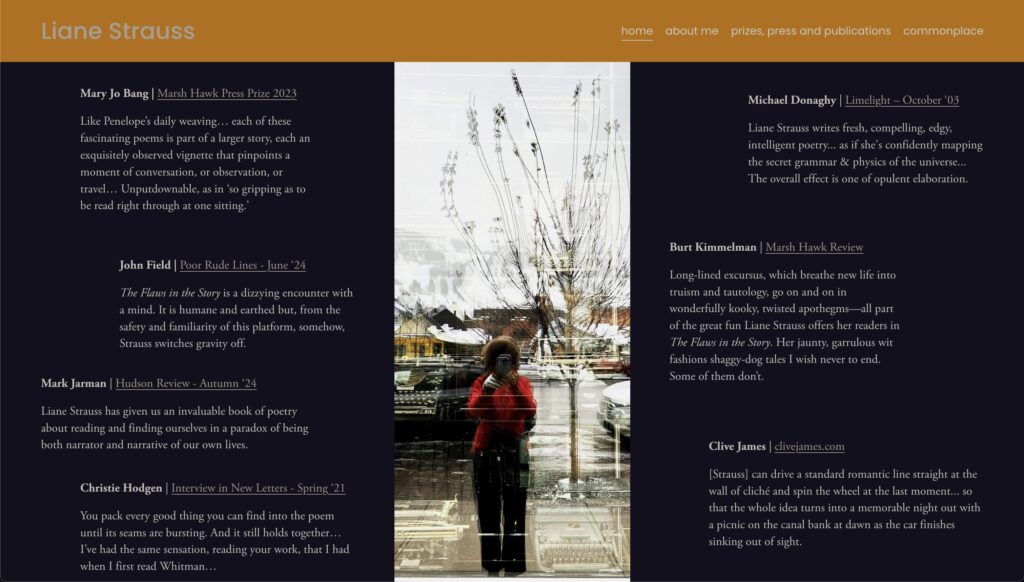
liane strauss (website)

liane strauss – poet and writer
lianestrauss.com

everyone's a critic (book in process)

⁠I’m putting together a book of bad reviews received by great (Western) artists before they were famous, the kind that others might have taken as a sign to give up on their art.

“I haven’t any right to criticize books, and I don’t do it except when I hate them. I often want to criticize Jane Austen, but her books madden me so that I can’t conceal my frenzy from the reader; and therefore I have to stop every time I begin. Everytime [sic] I read ‘Pride and Prejudice’ I want to dig her up and beat her over the skull with her own shin-bone.”
– Mark Twain

“Liszt’s orchestral music is an insult to art. It is gaudy musical harlotry, savage and incoherent bellowings.”
– Boston Gazette

“As to Hemingway, I read him for the first time in the early ‘forties, something about bells, balls and bulls, and loathed it.”
– Vladimir Nabokov

“Morrissey sometimes brings out records with the greatest titles in the world which, somewhere along the line, he neglects to write songs for.”
– Elvis Costello

how to read a poem (editor)

I’m the editor of the SubStack How To Read A Poem : A Love Story by poet and literature professor Dr. Liane Strauss, and have done some freelance editing in the past.

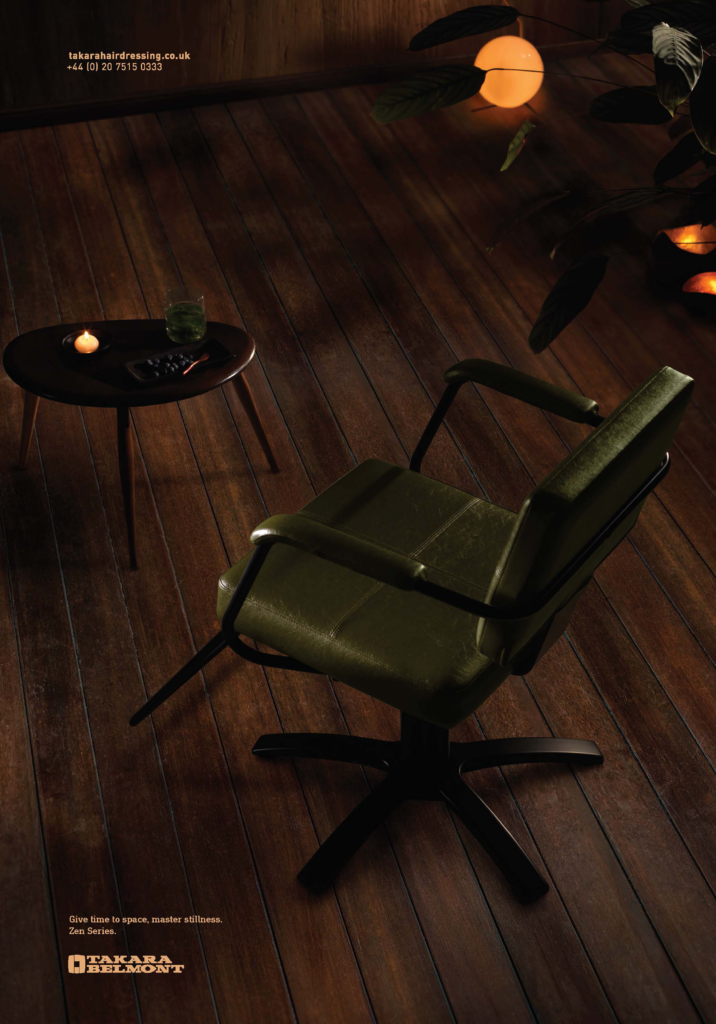
takara belmont (taglines)

While the majority of my work at Wireforks was auxiliary (and therefore hard to show off on a portfolio website), these taglines, invoking first effortless style and then ancient wisdom, were my first foray into writing copy independently. Each was published in a number of national and international salon industry magazines.

Of course, almost a decade later, I have notes for past me. But I know changing it now would be cheating, so…

NEW Apollo 2 with Classic heelrest:
the most traditional innovation in the world.
NEW Apollo 2 with Classic heelrest:
historically timeless, eternally peerless.
NEW Apollo 2 with Classic heelrest:
head to heel forever iconic.
Seek natural growth, harvest calm.
Zen Series
Give time to space, master stillness.
Zen Series
learnest (essay collection)

As part of my job as a Junior Creative at Wireforks (a boutique design firm in East London), I researched and wrote supplemental essays for a collection of posters aimed at children/young adults, which detailed the histories of various objects.

the grand hotel (card game)

the grand hotel was an independent project designed and produced alone as a solo entry to the d&ad new blood awards’ hasbro brief, which asked for a party game for millennials based on an existing game.

inspired by a drinking game and my love for the roaring 20’s, i created a luxurious, witty art deco styled card game for two or more people, printed a rough but fully playable pack, and wrote/recorded/edited a rough silly advert for it.

the great gatsby (dramturgical document)

OK, this is kind of embarrassing. I feel like my favorite novel should be something obscure and sexy by someone French or Japanese, but instead it’s this. I know it’s the book that every high schooler studies, the most obvious choice ever, but…
IT’S, LIKE, BASICALLY PERFECT.

Anyway I made a big interactive PDF thing for an adaptation of the play. It’s a little buggy but it works and there’s some interesting stuff in there.

nobody read it at the time, obviously.

download the pdf here! (the interactive stuff only works in adobe Acrobat)

take back the rains (awareness campaign)

take back the rains is a plan for a state-wide water rights awareness campaign to expose the stealing of our natural resources to be sold back to us.

personal writing
hamlet... in space! (essay)

Hamlet… IN SPACE!


In his book, Theater of the Unimpressed, Jordan Tannahill coins a term: Museum Theater, which he defines as “productions of plays that are content to simply be relics from the past. History lessons…, the killing and stuffing of once-mighty plays into theatrical taxidermy”. Broadway spits out another production of Glengarry Glen Ross, The Crucible, and Who’s Afraid of Virginia Woolf? like clockwork every few years, while across the pond the Globe Theater in London was directly conceived as a kind of theater museum, a place where today’s audiences could experience Shakespeare’s work as it was experienced at the time. A 2016 revival of My Fair Lady at the Sydney Opera House (directed by Julie Andrews herself) went so far as to exactly replicate the original’s production design from sets to costumes to lighting.

In response to criticism of this kind of theater a variation upon it has emerged, as the savvier artistic directors and producers search for a middle ground between the critical mandate for new and innovative theater and the financial security of known IPs. (It’s perhaps worth noting that the aforementioned production of My Fair Lady sold more tickets than any other in the history of the Sydney Opera House.)

I call this kind of production Hamlet in Space, named for the dialogue I imagine as its genesis:

ARTISTIC DIRECTOR
We need one more production to round out this season.

PRODUCER
Hmmm… We haven’t got a Shakespeare yet.

ARTISTIC DIRECTOR
Okay, what about… Cymbeline?

PRODUCER
Nobody’s heard of Cymbeline. Josh O’Connor’s not gonna play Cymbeline.

ARTISTIC DIRECTOR
He’s too young to- Okay fine, what about The Merchant of V- actually now’s probably not the time, is it?

PRODUCER
How about Hamlet? Everybody loves Hamlet.

ARTISTIC DIRECTOR
Ooh, and Josh O’Connor should definitely play Hamlet. But I don’t have any ideas for a production of Hamlet. And we can’t just do a straight production of it, everyone does that. Our subscribers expect more interesting work from *THEATER COMPANY REDACTED*.

A long pause.

PRODUCER
What about Hamlet… in SPACE?

ARTISTIC DIRECTOR
Hmmm. That could be interesting… Something about isolation, and being separate from the real world, looking down at it… Still, I’m not sure it totally works. Let me think-

PRODUCER
Huh? What are you saying? Whatever, I just sent out the email: Hamlet in Space opens in 3 months. Oh, and Josh is filming a movie for two of them. Good luck!

In other words, Hamlet in Space refers to a new production or adaptation of a recognizable text written more than… let’s say 50 years ago or so, with something unique (and, more importantly, marketable) stapled to its forehead.

a. A strikingly different setting, whether location or era based (sometimes as a framing device, sometimes as the entire production).
Macbeth in WW2; Othello in 2000s Iraq; Ubu Roi presented as the adolescent daydreams of an angry French teen whose parents are having a dinner party.


b. A compelling visual and/or theatrical style.
A Midsummer Night’s Dream with circus performers; A Doll’s House with no props; The Tempest but Ariel is on a screen.


c. An unorthodox casting choice, which usually involves either gender-bending, race-bending or character doubling. (Celebrity casting alone doesn’t count.)
Uncle Vanya but everyone is Andrew Scott; The Tempest but it’s Sigourney Weaver playing ProsperA; Death of a Salesman but they’re a black family.


d. A modern reimagining by a contemporary playwright that has something to say about the original property. (West Side Story doesn’t count, but & Juliet does.)
Fat Ham, A Tempest, A Doll’s House Part Two, John Proctor is the Villain


e. A combination of the above.

I should also clarify that, just as setting your production of Hamlet in space doesn’t automatically make the production a Hamlet in Space, just because a production fits into the genre of Hamlet in Space, does not mean it’s going to be bad. There’s nothing inherently wrong with any of these approaches to theater-making, and in fact some of the examples listed represent the best theater I’ve ever seen. The problem is a growing tendency for productions to be devised concept-first, seemingly more worried about the poster than the production, and left with no time to explore or develop the concept and find out what, if anything, is underneath.

Take the 2025 production of The Picture of Dorian Gray for example, in which Sarah Snook played an astonishing 26 roles. Central to the production were a collection of moving screens, onto which were projected live feeds from onstage cameras as well as pre-recorded footage, all of which allowed Snook to play the narrator and all the characters in a retelling of Oscar Wilde’s only novel, The Picture of Dorian Gray. I mention the narrator because, though they appear relatively rarely, they are the character with which the production begins and ends. They also represent the central problem with the production.

Let’s back up a bit: what is The Picture of Dorian Gray about? Well, plot-wise, it’s a story about a beautiful young man in 19th-century England who, upon seeing a finished portrait of himself, declares that he would sell his soul if he could stay as young and beautiful as he is now and the painting would age in his stead. His wish is granted, and he lives an immoral and hedonistic life for decades, with the only fallout the aging and scarring of the portrait he keeps locked away from view. There’s a bunch of plot after that but all you really need to know is he fucks up a bunch of people’s lives, murders the painter with a knife so he can’t tell everyone his secret, and eventually stabs the painting with the same knife. When his servants enter the room, they find the body of an impossibly old man with a knife through his heart, in front of a painting of a beautiful young man, totally intact. Good, right?

Now back to the narrator: the narrator is the first person to talk to us, setting the stage with the first lines of the novel. They are clearly very excited, almost breathless, to tell us this story. Soon the telling is being done by the characters Snook is playing (or at least by the narrator dressed as whichever character she was playing last), and Snook as the narrator is relegated to occasionally appearing on-screen to do this shtick where they think the next section of narration is their line but so does the Snook on stage, and they argue about it. (This happens twice, if I remember correctly.) Otherwise, their only other appearance is in the final moment of the play: after still-breathlessly reciting the final lines of the novel, they inhale as if to keep talking and are immediately silenced by a blackout.

In Wilde’s original text, the story is relayed to us by an omniscient narrator. Novels, particularly those written in the 19th century, are often narrated by an all-seeing eye with no clear stakes in the action of the story; to question this is almost like questioning why a novel is written in paragraphs. Narrators in theater are much more complicated. When a play has a narrator, the world of the play is made fundamentally less real. Narrators talk to the audience, and define the plot as a story being told to us rather than a situation unfolding before us. A living, breathing narrator implies a living, breathing motive: Why are they telling us this story? What does it do for them, and why do they need us to hear it? The reason can be grandiose or minor, altruistic or selfish — In Our Town, The Stage Manager wants to explain something about life and death, about America and collective memory; in The Drowsy Chaperone, Man in Chair is sharing his favorite musical with us as a way to keep his memories alive; in Brighton Beach Memoirs, Eugene is simply a talkative and imaginative kid with little to no recognition of what he should and shouldn’t say to people.

Dorian Gray retained the narrator from the novel, but didn’t reckon with the fact that doing so added a whole new character to the story, one that I would argue has the deepest internal life of any of them. The production used doubling and on-stage quick changes to stylishly conjure each new character, but didn’t consider how an audience would experience them as all being played by a single person and, more importantly, that it would want to know why.

I want to be clear: I was incredibly impressed by this production both in terms of the technical complexity and Snook’s powerhouse performance. Seriously, the woman is amazing, and the uses of video ranged from delightful to outright astonishing. But there’s a difference between impressive and effective. And that tends to be the big issue with a Hamlet in Space: it’s often the result of dozens of majorly talented people doing truly excellent work. But when that work is in service of a half-baked idea, there’s no amount of talent that can bake it whole.

Now, we’ve gone over what Dorian Gray is about, but what’s it about about? Vanity? Morality? Homoeroticism? A different theme that isn’t listed on the Wikipedia page? Kip Williams, the production’s writer and director, says that his Dorian Gray is about “gender, […] sexuality, [and] the performance of identity”. But, beyond the choice to cast a female actor as all the characters in a story populated mostly by men (and I guess just the fact of Oscar Wilde’s queerness?), I really don’t see how the production could be read that way.

We’re back in the land of conjecture here, but in my mind it went more like this:

*ring ring*

PRODUCER
Hey, you’re the director who uses screens and video footage, right? What’s something you could adapt with a lot of screens? Preferably something that can be worked on during COVID, because as you know it is the year 2020.

KIP WILLIAMS
Yeah, we’re probably gonna want to do something with one unmasked actor and a bunch of masked stagehands if we want to rehearse properly while still social distancing…

PRODUCER
Right, exactly. Screens, one actor… something about self-obsession?

KIP WILLIAMS
I mean, I’ve always loved The Picture of Dorian Gray. Haven’t read it in a while, but-

PRODUCER
Perfect! That’s sorted.

KIP WILLIAMS
But I mean, I’m not sure if-

*dial tone*

Dorian Gray’s fatal flaw is his vanity, the belief that his beauty, and therefore he, is superior to all others. This production seems to equate vanity with self-obsession, in an attempt to draw out the kind of Black Mirror-esque themes that every modern artwork has to comment on, criticizing the rampant overuse of photo editing and how the ubiquity of screens stokes the fires of our modern self-worship, et cetera, et cetera. But Gray’s vanity is less the constant preening self-attention of an Instagram model than it is the entitlement to do anything he feels like, bolstered by a perceived superiority that, yes, derives from his external beauty.

Furthermore, the self-obsession implied by a one-actor production, like that implied by a narrator, is of a third kind, that of the know-it-all, either because they are actually omniscient or just believe they are. And there’s the rub: people who know everything make really boring characters, especially when there’s nobody and nothing there to confound this certainty. At the end of the play we have watched someone pour themselves into the performance of this story over two hours, playing all these characters with this seemingly boundless energy… But why? They’re the only quote-unquote “real” person there, the one telling us this story, the only one who we can imagine will still be there when the lights go off. The other characters are puppets: they disappear when the narrator removes their costume, placed back in their box for next time. But here is the costume they cannot take off, the version of themself who started this whole mess, who has decided to tell us this story even as it seems to drive them to a kind of insanity. They’re the only one who transcends their identity as “a character” to become a whole person that we might relate to, but they seem to have been given the least amount of thought. And this is to me what happens when a production puts the cart before the horse, under-thinking a concept into a gimmick — “What if Hamlet but… in space?”

Why does this happen? Well, no prizes for guessing what I think if you know me: it’s capitalism! Sorry, I know, I know. But it’s true: the simple fact is that theater, like any other art, is best conceived through process, allowing for discoveries and complications, tangents and dead ends. Art at its most effective, like life at its most profound, is found in the in-between, in the unique process of its incidence; it can’t be rushed or pre-planned; this is what can make it so expensive, but also what makes it human. Hamlets in Space, though sometimes invigorated by some singular talent in the cast or crew, are fundamentally inhuman products, not so much process as processed, built for purpose and designed for efficiency.

Think of it like a handcrafted bookshelf versus one from IKEA. The IKEA piece is cheaper, lighter to carry, quicker to build (even if you always end up with some extra screws and bolts you’re not sure where to put). If that’s all you can afford, it certainly does its job. But at the end of the day you’ll be left with something flimsy and impersonal that doesn’t really fit with or add to what’s around it, and no way to keep the damn thing from wobbling.

this painting should have been an email (essay)

an inflammatorily-titled, less-long discussion of how art that makes you think before it makes you feel is more criticism than art.

all 'er nuthin' (essay)

an in-depth exploration of how mainstream theater performs its progress on stage with “race-blind” casting, while still allowing creative control to remain majority white, and how their risk-aversion is arresting not only societal but artistic advancement. exploring topics from laurence olivier’s baffling 1965 performance as othello (and pauline kael’s equally baffling rave review), to daniel fish’s 2019 production of “oklahoma”, and beyond!

colorado (short comic)

a semi-fictionalized account of a summer i once spent in colorado, and a portrait of the more ambiguous and important relationships one can have in life, and then let go of. this was a completely individual project, written and illustrated by me alone. I think it turned out pretty good.

dynamic change consultants (website)

Dynamic Change Consultants (Design and Copy)
dcc.com

friends of musique et vin (website)

friends of musique et vin (Design)
fomv.org

liane strauss (website)

liane strauss – poet and writer
lianestrauss.com

mac demarco - 2 (album cover)
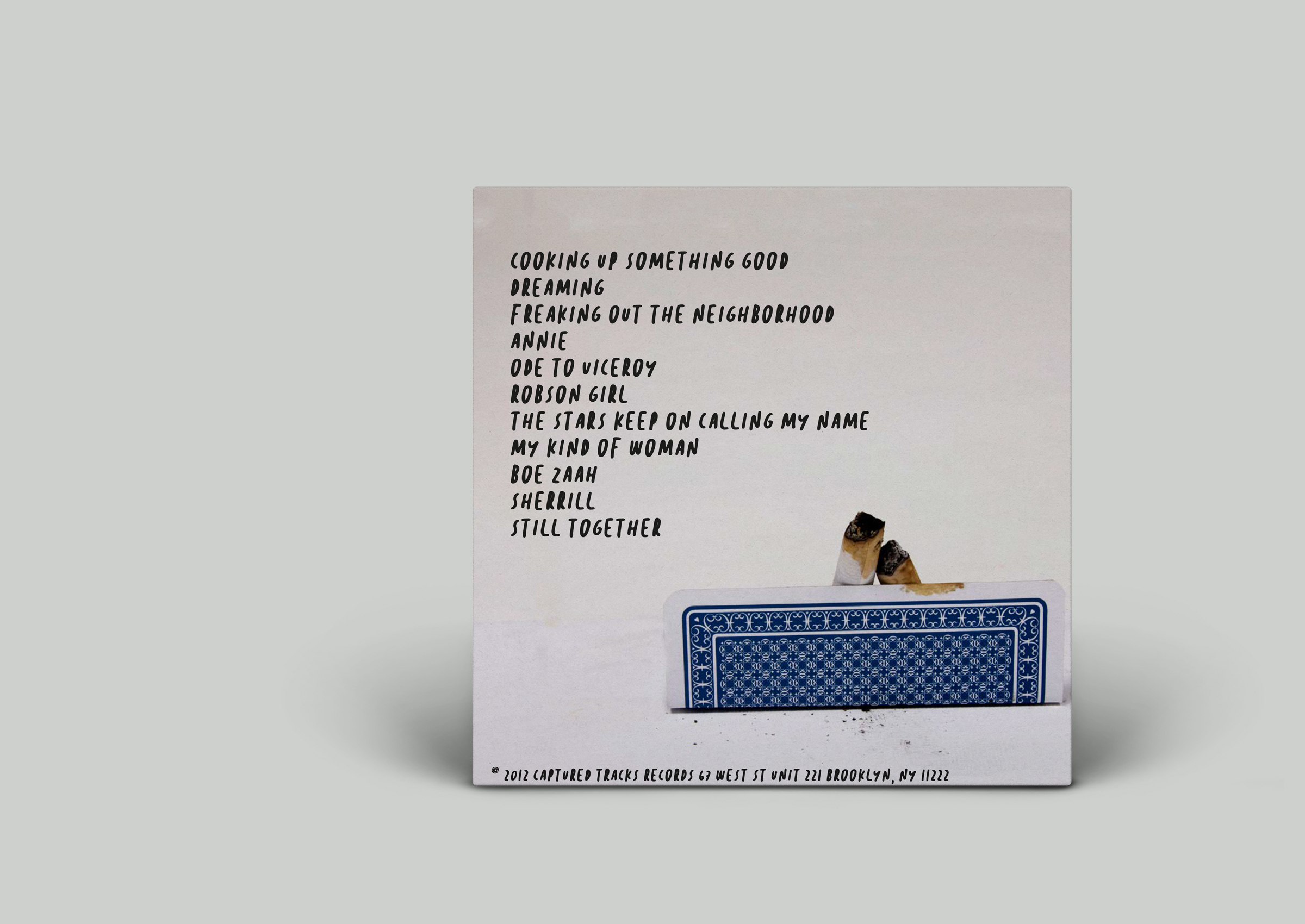
listen closely to “2”, mac demarco’s first full-length album, and you’ll find that behind the lilting psychedelic guitar and gap-toothed smile, he is detailing an at-once familiar and deeply personal picture of adolescence. he bounces effortlessly between themes, from worrying about worrying his parents to deep, guileless love, to that feeling that life has more in store for him. this album cover was created to reflect that, using dirty and classically teenage objects to create an affectionate and earnest moment.

take back the rains (awareness campaign)

take back the rains is a plan for a state-wide water rights awareness campaign to expose the stealing of our natural resources to be sold back to us.

the grand hotel (card game)

the grand hotel was an independent project designed and produced alone as a solo entry to the d&ad new blood awards’ hasbro brief, which asked for a party game for millennials based on an existing game.

inspired by a drinking game and my love for the roaring 20’s, i created a luxurious, witty art deco styled card game for two or more people, printed a rough but fully playable pack, and wrote/recorded/edited a rough silly advert for it.

carnival of the animals (costume design)

my first experience designing costumes was for a hypothetical production of camille saint-saëns’ posthumously-released suite the carnival of the animals, a collection of short, animal-themed pieces, complete with ogden nash’s silly interstitial poems read by a narrator. like the best children’s media, this series has plenty for adults to enjoy as well, and i wanted to capture that in my designs, focusing on recognizable characters and conflicts within each piece.

daisy miller (collage novel)

Henry James’ 1878 novella Daisy Miller – A Study in Two Parts is an example of James’ career-long struggle with his trans-Atlantic identity as a US-born Brit, and the tug-of-war between the promised freedom of America and the comfortable formality of Europe.

While over 100 years old, the novella is still deeply relatable: Daisy dies raging against the conformity expected of her, while Winterbourne gives up on his freedom in favor of stability. Collage seemed the perfect medium to express this uncomfortable juxtaposition of the old and the new, the free and the caged.

I’ll finish it one day.

colorado (short comic)

a semi-fictionalized account of a summer i once spent in colorado, and a portrait of the more ambiguous and important relationships one can have in life, and then let go of. this was a completely individual project, written and illustrated by me alone. I think it turned out pretty good.

the great gatsby (dramturgical document)

OK, this is kind of embarrassing. I feel like my favorite novel should be something obscure and sexy by someone French or Japanese, but instead it’s this. I know it’s the book that every high schooler studies, the most obvious choice ever, but…
IT’S, LIKE, BASICALLY PERFECT.

Anyway I made a big interactive PDF thing for an adaptation of the play. It’s a little buggy but it works and there’s some interesting stuff in there.

nobody read it at the time, obviously.

download the pdf here! (the interactive stuff only works in adobe Acrobat)

the history of the airplane

Humanity had been flying for more than 100 years by 1903, starting with the Montgolfier brothers’ hot air balloon in 1783, but it was an American brother team, Wilbur and Orville Wright, who built the Wright Flyer (1), marking the first successful manned flight in a heavier-than-air craft, and inspiring generations of aeronautic engineers.

One of those heavily influenced by this boom was Igor Sikorsky, a Russian engineer who would eventually become a great innovator both of helicopters and intercontinental airliners. In 1914, a 25-year-old Sikorsky built the plane that established his reputation. A more refined and practical version of his earlier plane ‘Russkiy Vitaz’, the Il’ya Muromets (2) was the first mass-marketed multi-engined aircraft. Becoming prevalent as both a luxury liner and as a bomber, it established his reputation as an innovator, and anticipated decades of aeronautic development trends.

Even after WW1 aeronautics were still largely a novelty for the general public. However, with the arrival of the Douglas DC-3 (3) in 1936 a gruelling 25-hour journey across its native US that had required three planes and many more stops became a single-plane, 15-hour trip with just three stops. The DC-3 is considered the first plane able to make money carrying passengers.

The Second World War elevated more than a few planes to the status of ‘icon’ – the British Spitfire and the German Messerschmitt, for instance – but none was so groundbreaking as American aviation company Boeing’s B-29 Superfortress (4): Most famous perhaps for delivering the final blow to Japan at the end of the war, the Superfortress, introduced in 1944, was fitted with many ahead-of-its-time technological advancements. Five years later, in 1949, it was the first plane to fly around the world without stopping.

The Superfortress was also the mother ship of numerous other experimental aircraft, including the Bell X-1 (5), the first ever of the X-planes, a series of experimental United States aircraft and rockets, used to test and evaluate new technologies and aerodynamic concepts. X-planes are still being created and experimented with. Manned by American paragon Chuck Yeager in 1946, the X-1 was the first plane to break the sound barrier.

As air travel grew increasingly ubiquitous, the focus of its innovations began to change: In late 1957, the CIA and Lockheed began work on the Lockheed SR-71 Blackbird (6) which is still today the world’s fastest airplane, with a top speed of Mach 3.3 (over 2,200 mph). These days, however, it has been supplanted as the spy craft of choice by unmanned drones.

A few years later, on the other side of the Atlantic, the British created the world’s first vertical take-off and landing (VTOL) combat aeroplane to enter operational service, the Hawker Siddeley Harrier (7). Though helicopters had existed for decades, the Harrier brought new velocity to VTOL craft.

Around the same time, Boeing were working on what would become the original ‘jumbo jet’, the Boeing 747 (8). Aided by its upper-deck which gave it its signature hump, the 747 held the passenger capacity record for 37 years (276 passengers), now held by the Airbus A380-800 (835 passengers).

While the Russian Tupolev Tu-144 beat the French Concorde (9) into flight by two months, a huge marketing push, which ranged from international advertising campaigns to an ill-conceived 1979 action film starring, among others, Academy Award-winner George Kennedy (Cool Hand Luke), helped make Concorde the longer-enduring of the only two supersonic jets ever to carry commercial passengers.

Most planes have historically been used either for war or transportation, but there are some that are marketed to individual pilots and hobbyists. The most famous of these is the American Cessna 172 (10). Released in 1956, this four-seater is the highest selling plane of all time at more than 43,000 units sold, and can be found in most small airports and flight-training schools around the world.

In home-plane-building circles, VanGrunsven is a hallowed name. Van’s Aircraft RV-3 (11), launched a 70’s boom of kit-built single-seater craft; these days, the number of VanGrunsven-designed homebuilt aircraft produced each year in North America exceeds the combined production of all other commercial general aviation companies.

the history of recorded sound

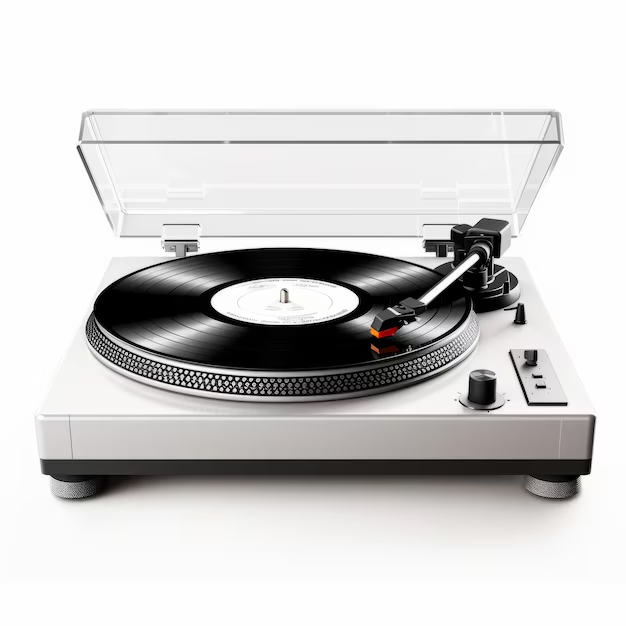
In 1857, French inventor Édouard-Léon Scott de Martinville patented what he called the “Phonautograph”, a device modelled on the human ear canal which was the first capable of recording sound, as lines on paper or blackened glass. Absurd as it may seem to us, it was a further twenty years before anyone considered that this technology could be used for playback. Thomas Edison’s 1877 Phonograph (1) was the first, able to play back sound etched into tinfoil-wrapped cylinders. It was a great success, soon spawning so-called ‘Phonograph Parlors’ (in which one could feed a coin into a phonograph to hear a certain song through stethoscope-like tubes) in major cities across the world, and establishing the recorded music industry in the process.

Edison had considered formats other than the cylinder, including the flat disc, but had decided against it, not predicting the need to store large collections of recordings. It wasn’t until 1887 that German inventor Emile Berliner created a variant on the phonograph that he named the Gramophone (2), for which he invented the earliest process for making flat records, etching grooves into zinc discs. With a few tweaks, this process was able to produce duplicated recordings more cheaply and in greater quantity than Edison’s cylinder, and the format quickly became the industry standard.

Radio had been around for decades upon the release of the first transistor radio, but had always been confined to one place, similar to a television. With the Regency TR-1 (3), one could bring the radio wherever they went. Cheap to manufacture and therefore to buy, this first transistor radio brought radio to the height of its influence, and was a huge success, spawning many variations and copycats over the coming years.

Up until the 1960’s, the music industry had been dominated by records, updates and variations of Emile Berliner’s gramophone. The 1960’s, however, proved to be the inception of the cassette age, beginning with the Philips-invented compact cassette, first released with the first cassette player, the Philips EL-3302 (4). Philips successfully marketed the cassette over the coming years, making the format free to use and moulding it into a serious competitor to vinyl in the 1970s.

Two years later, a consortium of American companies including Ford, GM, Motorola, and RCA Victor Records collaborated on a new audio format called the 8-Track, along with the Stereo 8 Player (5), the first automobile-integrable audio device.This chronology may come as a surprise to those who were alive at the time, considering that the 8-track, with its better sound quality and the promotion of some of the largest companies in the world, was by far the more successful in the early stages of their competition.

The compact cassette only really came into its own in the early ‘70s, once its audio quality caught up to the 8-Track’s. However, it truly reached its apex in the years following Sony’s 1979 release of the Walkman (6), one of the most iconic gadgets of the 1980s. The Walkman was not only a private, portable disco (it came with headphones and no external speaker) but, coinciding with the aerobics craze of the late ‘80s, it became an integral exercise tool, contributing greatly to cassettes overtaking vinyl as the most-used format in 1983.

At the same time as its peak, the compact cassette was being primed for usurpation, with the invention of the CD by the rare alliance of Philips and Sony. Releasing the CDP-101 (7) in conjunction with the new format, Sony and Philips pushed for the CD to become the new normal for audio; one such push was the exclusive release of the 1985 ‘Dire Straits’ album to CD, which was so successful that it gave rise to a Philips-sponsored tour. With more CD innovations (i.e Discman) CD sales overtook vinyl by 1988, and the cassette by 1991.

The MP3 file, developed through the 80s and into the 90s, first came to prominence on the internet, mostly as an underground means of sharing tracks. Therefore, when SaeHan Information Systems released the first portable MP3 player, the MPMan (8), in 1998, critics of the time considered it little more than a tool for illegal music pirates, despite the technological advancement. It wasn’t until three years later, in 2001, when Apple unveiled its first Apple iPod (9), alongside its proprietary online music shop, iTunes. iTunes brought instant legitimacy to the format, making iPod the first commercially successful MP3 player, and starting in earnest Apple’s next few decades’ of technological domination.

the history of the boat

Although we have no physical evidence of boats dated before 8000 BC, there is evidence of human settlement, on islands like Flores in Indonesia, suggesting that rudimentary Rafts (1) were used as early as 900,000 years ago.

The oldest boat in the world, dating back about 10,000 years to the Neolithic Stone Age, is a Dugout Canoe (2). This stands to reason, as a massive piece of solid wood is likely to preserve much better than other primitive boats like hide kayaks and bark canoes, which may have come earlier.

The first direct archeological evidence of Sailing Boats (3) comes from Eastern Europe and Mesopotamia, dating to at least 6000 BC. These early versions were more like rafts fitted with a makeshift cloth sail, and gave primitive crafts new speed.

It was the Ancient Egyptians who, by around 3000 BC, began to build the sail boat as we know it, with their River Boat’s (4) square sail affixed to a hull made of wooden planks. The most notable discovery in this field is an intact full-size vessel dating from 2500 BC, found sealed in a pit near the Great Pyramid of Giza.

A Galley (5) is a mainly human-powered ship with sails available for use in favourable winds, and was first built in the middle of the 3rd millennium BC by a Mediterranean empire, most likely the Phoenicians or Egyptians. That its locomotion was man-powered allowed it to navigate winds and currents with greater independence.

Originally, the galley’s sole military use was ferrying soldiers from one place to another. However, the Dedicated War Galley (6), with a design sleeker and speedier than the bulky merchant ships, began to be built around the 14th century BC, again by an unknown Mediterranean power, this time most likely to be the Greeks. With the later addition in 800 BC of the bronze ram, the galley would not be usurped as the warship of choice for millennia.

First built in the 2nd century AD, the Chinese Junk (7) is a type of ancient Chinese sailing ship that is still in use today. This sizeable sailing ship was one of the first large ships without oars, and the explosion of their popularity in the 10th-13th centuries was symbolic of a global shift from galleys to sailing ships at the time.

The Viking Longship (8), originating from 4th century Scandinavia, represents the perfection of the war galley; Long, sleek and graceful, the longship is clearly designed for speed. Longships were in fact double-sided, meaning that they could reverse easily without rotating the whole ship.

Small and easily manoeuvrable, the Caravel (9) was a Portuguese sailing ship developed in the 15th century for exploratory purposes. It supplanted its contemporary rivals, like the cog or the carrack, with its size and shallow keel (underside) allowing it to sail in river-waters as well as the sea.

The iconic Galleon (10), famously used by both the Spanish and English fleets in the 1588 Battle of Gravelines, was in fact developed as a variation on the carrack, a less long, less tall ship which in turn began to be used exclusively as a merchant ship. Cheaper and more heavily armoured than its contemporary counterparts, the galleon spread through Europe throughout the Age of Sail (16th-18th centuries).

The Schooner (11), one of the most popular ships of the 18th and 19th centuries is often thought of as an American ship (i.e., the Clipper), but was in fact first developed by the Dutch. Popular among pirates in the West Indies for their speed and agility, the schooner was the craft of choice for trade which relied on speed, such as privateering or slaving. The Age of Sail is considered to have ended with the creation of the Suez Canal in 1869, which was impractical for sailboats and brought steamboats to the forefront.

The very first commercial steam-powered ship, built in 1802, was a Paddle Steamer (12), a riverboat whose steam engine drives paddle wheels to propel the craft. By the late 19th century, paddle steamers were very successful on rivers across the developed world, and steam power was now being applied to many other ships.

With the invention of the steamboat out of the way, it was only a matter of time before larger commercial ships began to experiment with steam power. Early successes led to experimentation with longer distances, culminating in the first ocean crossing by a steamship, the SS Sirius arriving in New York from Liverpool propelled by both steam engines and sails depending on the wind. This was the first true Ocean Liner (13), and led to the creation of the first cruise ship.

The first steam-powered warship was the Ironclad (14), a large frigate-like craft protected by iron or steel plates, first built in 1860. The Ironclad so successfully started a trend of large metal steam-powered warships that it caused its own obsolescence, and was replaced by the craft it inspired, its descendants too specialised (as designated battleships or armoured cruisers) to warrant the Ironclad’s continued production.

Most modern boats are in fact descendants and types of the Speedboat (15), defined as any boat powered by an engine. The first speedboat, built in 1888, was a matter of great public interest, and led to the first yacht being launched a few years later. During the first ever yacht race, in 1903, many of the boats did not even start.

Also known as an air-cushion vehicle (or ACV), a Hovercraft (16) is a boat capable of travelling over both land and water. Air blowers which produce a large volume of slightly-above-atmospheric-pressure air allow its inflating ‘skirt’ to essentially float on top of the air. Invented in the early 20th century, hovercrafts are mostly used as rescue craft because of their versatility.

the history of the camera

The first camera was based upon the principles of the ‘camera obscura’, a technology that some believe has been known since prehistory. Essentially a box with a small hole in it, when light from an external scene passes through a camera obscura an image of it is projected, upside-down and inverted, onto a surface inside the box/cave/etc. Nicephore Niepce’s first camera (1) was essentially an updated version of the camera obscura, combined with the technology he had invented to print negative photographs on silver chloride-coated and, in 1816, he created the first ever photograph.

When the Eastman Company rebranded in 1892 to the Eastman Kodak Company, it brought with it a new slogan, “You press the button, we do the rest”, and a new camera, the Kodak n°1 Pocket camera (2). The first folding model of the Kodak camera, it radically changed the landscape of amateur photography, as both cameras and printing processes of the time were too demanding to be considered personal recreation. Kodak changed this by offering development services at their stores.

Twelve years later, in need of a way to begin selling the new film they were making, Kodak introduced another camera, the Kodak Brownie (3). With users able to reload it themselves, the simplicity of one button, and the incredible price of $1 (equivalent to around $40 today), the Brownie revolutionised the mass-market for cameras and photography, making it more and more attainable to ordinary people.

In 1911 German designer Oscar Barnack was tasked with designing a movie camera. Because the 35mm movie film he was using had an inconsistent emulsion speed, Barnack created a small device to test each film batch he bought. In fact, he had unwittingly invented the first 35mm still camera portable enough to be considered commercially viable; in 1925 the Leica I (4) was the first commercially available 35mm still camera, and its instant success was instrumental in popularising 35mm.

Before the popularisation of the SLR (Single Lens Reflex) camera, light had to enter the camera in two places: the lens in front of the film, and the viewfinder in front of the photographer’s eye. The German-made Imagee Kine Exakta 1 (5) was the first commercial SLR camera, which, with its single lens, allowed the photographer’s view to be the same as the view that the camera would see.

Modern as it was, however, the Kine Exakta had a waist-level viewfinder, which required the user to look down through it to see the image in front of them. The first 35mm SLR with a pentaprism, a reflective five-sided prism used to flip the image and allow the user to shoot at eye level, was German company Zeiss’ 1949 Contax S (6) camera.

1957 brought the Asahi Pentax (7), the 35mm SLR so successful that it shaped camera design and standardised placement of controls for years after in ways that still affect us today (the shutter button is still in the same place, for instance). Previously, too, most lenses could only be mounted on cameras of the same make: Pentax’s success made its 42mm screw lens mount one of the first to be adopted outside of proprietary products, allowing owners to mount lenses crafted by other companies.

Kodak’s 1963 release, the Instamatic (8), is a spiritual successor to the Kodak Brownie: a simple point-and-shoot camera that anybody could use without difficulty. It was inexpensive both to make and to buy, easily reloaded with film, and came with a built-in flashgun. The Instamatic’s immense success (50 million were sold between 1963-70) is credited with inspiring the point-and-shoot camera revolution of the later 1970’s and 80’s.

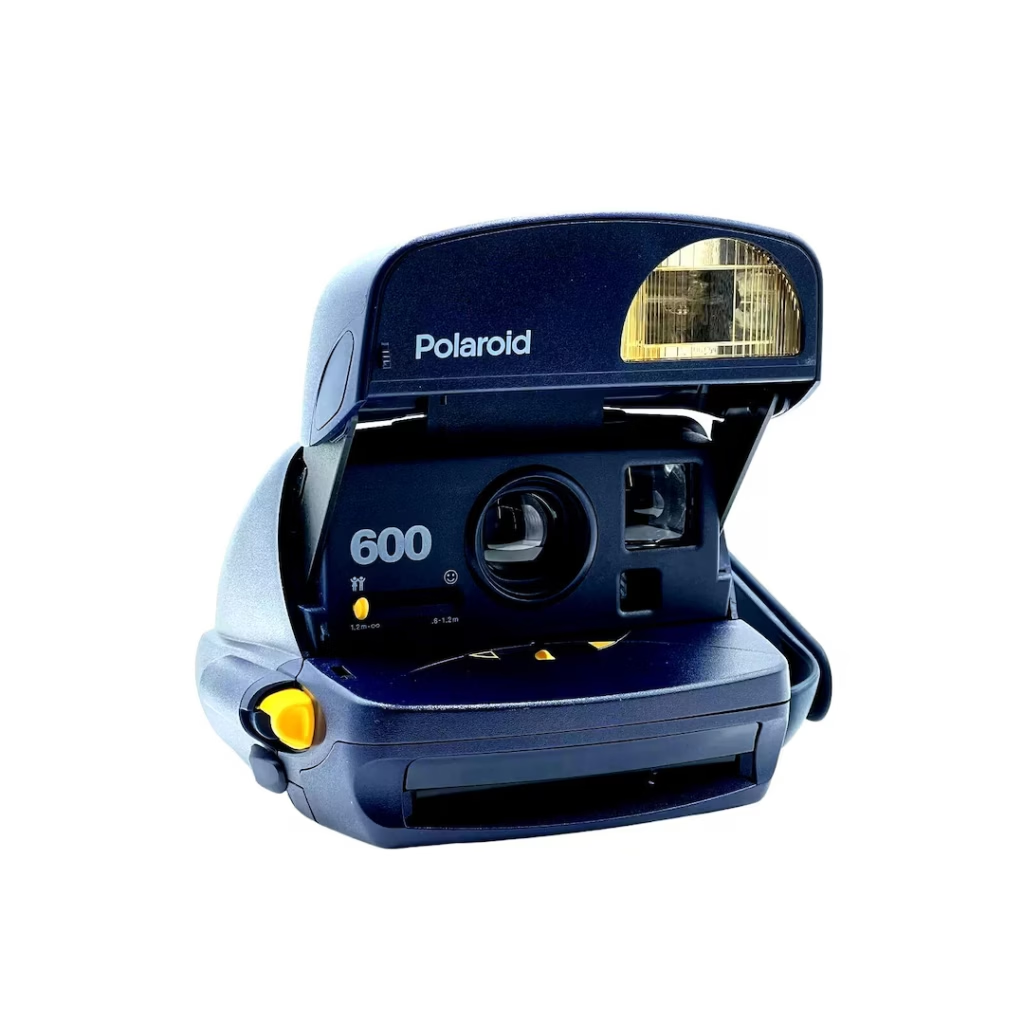
While Polaroid brought out the first instant camera in 1947, the popularity of the technology didn’t come until decades later, with the Polaroid SX-70 (9). Other Polaroid cameras had been impressive but very difficult to use, requiring complex processes and often leaving developing chemicals on hands. The SX-70, conversely, was quick, clean, and easy-to-operate, inspiring a polaroid revolution led by such artistic leaders as Andy Warhol and Helmut Lang.

It is certainly a strange sight, to see a Nikon camera on top of a Kodak-labelled unit, but the original DSLRs (Digital SLRs) all derived from the Kodak DCS (10) (Digital Camera System), based on existing Nikon cameras. The DCS was the first commercially-available DSLR, and came with removable cards, probably the most important innovation because the photographer could take out the card, insert another, and quickly keep on shooting.

Not even the first Nokia cameraphone, the Nokia 6600 (11) is simply the best-selling of any of Nokia’s cameraphones, and contributed greatly to the milestone reached in 2008, when Nokia became the largest camera (not just cameraphone) seller in the world. These days, the cameraphone is the most common way we take pictures, especially with the advent of social media platforms like Instagram.

the history of light

The control of Fire (1), estimated to have occurred 125,000 years ago, was a turning point in human evolution for a number of reasons, from its heat which allowed us to survive harsh weather to the protection it offered from wild animals. However, the artificial light it also provided is credited with giving humans one of their main advantages over most other mammals: a longer waking day. While most mammals are only awake for 8 hours per day, fire allowed for the shifting of our circadian rhythms, giving humans a 16-hour waking day, and contributing greatly to the speed of our advancement.

Many anthropologists believe that primitive versions of the Oil Lamp (2) may have been in use as early as 70,000 years ago. The oldest discovered oil lamp was found in a cave believed to have been inhabited 10,000-15,000 years ago, but oil lamps continued to be used practically until the 1800s, and are used in religious ceremonies to this day.

Candle (3) making was developed independently in many places throughout history. The Ancient Greeks are believed to have been the first to discover it, using them to honour the goddess Artemis on the sixth day of every lunar month. (Incidentally, this is believed by some to be the reason we blow out candles on our birthdays.) The Romans began making the kinds of candles we would recognise, dipped candles, around 500 BC, although wick-lit oil lamps were still their main source of light.

For millennia, candles and oil lamps were all that was available for illumination. Innovations and advancements were certainly made, from the chandelier to the cotton wick, but Aimé Argand’s was the most notable. Invented in 1780, the Argand Lamp (4) was a kind of oil lamp with an output at least 6 times as bright as a candle, much brighter than earlier oil lamps. A quick success, it became the main lighting appliance for almost a century.

William Murdoch’s invention of the Gas Lamp (5) in 1792 brought artificial lighting into line with the Industrial Age, allowing the controlled illumination of streets, factories, and theatres which had been previously very difficult to light. Gas lighting continued to be used in streetlights up until the early 1900s, when the growing popularity of electric lighting finally took over.

The Arc Lamp (6), so-called for its lighting mechanism of an electric arc between two carbon electrodes, was invented in the early 1800s by Humphry Davy, but its use only became widespread starting in the 1870s as a replacement for gas streetlights. Arc lighting was replaced in the early 20th century by the much less volatile incandescent lightbulb.

Ignacy Łukasiewicz invented the modern Kerosene Lamp (7) in 1853, following the discovery of petroleum refinement, which created a lamp fuel cheaper than gas and oil called kerosene. Kerosene lamps of this design are still extensively used in unelectrified areas, and both the cost and the dangers of combustion are a continuing concern in many countries.

One of the great debates in the history of science surrounds the Incandescent Lightbulb (8), specifically whose invention it truly was; many people would answer Thomas Edison, broadly considered to be the grandfather of electric lighting. However, Edison’s lightbulb was a culmination of many decades of other discoveries, including an 1800 demonstration of a glowing wire by Alessandro Volta, the inventor of the electric battery after whom voltage is named. Whoever invented it, the incandescent lightbulb changed almost every aspect of human life, and is still used worldwide, in spite of an environmentalist push to phase them out.

When the element Neon was discovered, in 1898, it was quickly discovered to be the perfect gas for a preexisting novelty of the time, the Geissler Tube. Named for Heinrich Geissler, these were glass tubes full of a gas that, when electricity was applied, gave off different coloured lights depending on which gas was inside. Neon, unlike the previous gases, lasted much longer in these tubes, and emitted much brighter light, giving rise to what we now know as Neon Lighting (9).

Neon lighting’s success led to similar innovations with other chemicals, most notably mercury vapour, which fluoresces when exposed to electricity. A Fluorescent Tube (10) is a glass tube of mercury vapour, a gas that, when exposed to electricity, causes a phosphor coating to produce visible light. Invented at American industrial giant General Electric in 1937, by 1951 the country was lit more by fluorescent light than incandescent, and most of the world soon followed.

The Halogen Lamp (11) is a high intensity incandescent lamp that, due to its small size and high output, is used in things like car headlights, motion picture projectors and the heating-elements in electric ceramic cooktops. They are used sparingly for the same ecological reasons as their regular incandescent counterparts.

Based on theoretical work by Albert Einstein, bolstered by studies by scientists at Bell Laboratory, and with a name coined by a graduate student at Columbia University, the LASER (12) (originally an acronym: Light Amplification by Stimulated Emission of Radiation) is another invention built upon the work of multiple unrelated parties. Even stranger, the first laser was built by none of these parties, but by scientist Theodore H Maiman in 1960.

Although electroluminescence was discovered in the early 20th century, and was studied throughout, the Light Emitting Diode (13) as we know it today was invented in 1961, first only emitting infrared light, and then visible red light a year later. As the technology advanced, LEDs were invented that could emit white light, and their output and efficiency rose to the point that, as of 1995, they have been increasingly used as replacements for incandescent and fluorescent lighting.

Compact Fluorescent Lamps (14), or CFLs, were invented in 1976 specifically for energy saving purposes. Although they are 75% more energy efficient than incandescent bulbs, and last up to 10 times longer, they are still fluorescent, and the mercury they contain makes them less eco-friendly than modern LED lamps.

if you want to reach me,
leave me alone

- sheryl crow (a change would do you good

[just kidding i'm very lonely please write to me]